DEF 14A: Definitive proxy statements
Published on January 27, 2026
UNITED STATES
SECURITIES AND EXCHANGE COMMISSION
Washington, D.C. 20549
SCHEDULE 14A
Proxy Statement Pursuant to Section 14(a) of the
Securities Exchange Act of 1934
Filed by the Registrant x | Filed by a Party other than the Registrant o | ||||
Check the appropriate box:
| o | Preliminary Proxy Statement | ||||
| o | Confidential, for Use of the Commission Only (as permitted by Rule 14a-6(e)(2)) | ||||
| x | Definitive Proxy Statement | ||||
| o | Definitive Additional Materials | ||||
| o | Soliciting Material under §240.14a-12 | ||||
________________________________________________________________
(Name of Registrant as Specified in its Charter)
N/A
________________________________________________________________
(Name of Person(s) Filing Proxy Statement, if Other Than the Registrant)
Payment of Filing Fee (Check all boxes that apply):
| x | No fee required. | |||||||
| o | Fee paid previously with preliminary materials. | |||||||
| o | Fee computed on table in exhibit required by Item 25(b) per Exchange Act Rules 14a-6(i)(1) and 0-11. | |||||||

NOTICE OF ANNUAL MEETING OF STOCKHOLDERS
TO BE HELD ON TUESDAY, MARCH 24, 2026
NOTICE IS HEREBY GIVEN that the 2026 Annual Meeting of Stockholders (the “Annual Meeting”) of Construction Partners, Inc. (the “Company”) will be held on Tuesday, March 24, 2026, at 11:30 a.m., Central Time, at the DoubleTree by Hilton, located at 2740 Ross Clark Circle, Dothan, Alabama 36301. The Annual Meeting is being held for the following purposes:
1.to elect two Class II directors to serve for a three-year term expiring at the 2029 Annual Meeting of Stockholders;
2.to ratify the appointment of RSM US LLP as the Company’s independent registered public accountant for the fiscal year ending September 30, 2026; and
3.to transact such other business as may properly come before the Annual Meeting or any adjournment, postponement or recess thereof.
The Board of Directors has established January 23, 2026 as the record date for the Annual Meeting. Only holders of the Company’s Class A or Class B common stock at the close of business on the record date are entitled to notice of, and to vote at, the Annual Meeting and at any adjournments, postponements or recesses thereof.
The accompanying proxy statement provides you with detailed information about the proposals to be voted on at the Annual Meeting. With the accompanying proxy statement, we are also including a copy of our 2025 Annual Report on Form 10-K (the “Annual Report”) in order to provide you with additional information about the Company. We encourage you to read the accompanying proxy statement and the Annual Report carefully.
The Annual Meeting may be adjourned from time to time without notice other than announcement at the Annual Meeting, and any business for which notice is hereby given may be transacted at any such adjournment.
| By Order of the Board of Directors, | |||||
 | |||||
| Ned N. Fleming, III | |||||
| Executive Chairman of the Board of Directors | |||||
| Dothan, Alabama | |||||
January 27, 2026 | |||||
TABLE OF CONTENTS
| Page | |||||
Compensation Discussion and Analysis | |||||
CONSTRUCTION PARTNERS, INC.
PROXY STATEMENT
FOR THE ANNUAL MEETING OF STOCKHOLDERS
TO BE HELD TUESDAY, MARCH 24, 2026
This proxy statement (the “Proxy Statement”), along with the accompanying Notice of Annual Meeting of Stockholders (the “Notice”), is furnished on behalf of Construction Partners, Inc. (the “Company”) by its board of directors (the “Board”) and management in connection with the solicitation of your proxy to be voted at the 2026 Annual Meeting of Stockholders of the Company (the “Annual Meeting”) to be held at 11:30 a.m., Central Time, on Tuesday, March 24, 2026, at the DoubleTree by Hilton, located at 2740 Ross Clark Circle, Dothan, Alabama 36301, and at any adjournments, postponements or recesses thereof.
In this Proxy Statement, unless the context suggests or requires otherwise, references to “the Company,” “we,” “us” and “our” mean Construction Partners, Inc., a Delaware corporation, and, as appropriate, its subsidiaries. References to “SunTx” mean SunTx Capital Partners, a private equity firm based in Dallas, Texas. References to the “SunTx Group” mean a voting group led by SunTx and comprising certain of our directors and officers and their respective affiliates, who collectively own a controlling interest in our common stock.
We began mailing this Proxy Statement and the accompanying Notice on or about January 27, 2026 to all stockholders of the Company entitled to vote at the Annual Meeting.
________________________________________________________________
IMPORTANT NOTICE REGARDING THE AVAILABILITY OF PROXY MATERIALS FOR THE
ANNUAL MEETING OF STOCKHOLDERS TO BE HELD ON MARCH 24, 2026
This Proxy Statement is available for viewing, downloading and printing at www.proxyvote.com. Additionally, you can find a copy of our Annual Report on Form 10-K for the fiscal year ended September 30, 2025 (the “2025 Annual Report”), which includes our annual financial statements, on the website of the Securities and Exchange Commission (the “SEC”) at www.sec.gov, or by following the “Investors - SEC Filings” link on our website at www.constructionpartners.net. The information contained on, or accessible from, our website is not part of this Proxy Statement by reference or otherwise. You may also obtain a printed copy of our 2025 Annual Report, including our financial statements, free of charge by sending a written request to the principal executive office of the Company at the following address: Construction Partners, Inc., 290 Healthwest Drive, Suite 2, Dothan, Alabama 36303, Attention: Secretary. Exhibits will be provided upon written request and payment of an appropriate processing fee.
IMPORTANT INFORMATION ABOUT THE ANNUAL MEETING AND VOTING
Why am I receiving these materials?
The Board, on behalf of the Company, is providing these proxy materials to you in connection with the Annual Meeting. Stockholders are invited to attend the Annual Meeting and are requested to vote on the proposals described in this Proxy Statement. This Proxy Statement, along with the Notice, summarizes the purposes of the Annual Meeting and certain information that will assist you in determining how to vote at the Annual Meeting.
What is a proxy?
A proxy is your legal designation of another person, called a proxy holder, to vote the shares that you own. If you designate someone as your proxy holder in a written document, that document is called a proxy. We have designated Ned N. Fleming, III, our Executive Chairman, Fred J. (Jule) Smith, III, our President and Chief Executive Officer, and Gregory A. Hoffman, our Senior Vice President and Chief Financial Officer, to act as proxy holders at the Annual Meeting as to all shares for which proxy cards are returned or voting instructions are provided by internet or telephonic voting.
What is a proxy statement?
A proxy statement is a document that SEC regulations require us to give you when we ask you to sign a proxy card designating the proxy holders described above to vote on your behalf.
Who is soliciting my proxy?
This proxy solicitation is being made on behalf of the Company by its Board and management. The cost of this solicitation, including the cost of distributing the proxy materials, will be borne by the Company. Officers and employees of the Company may solicit proxies, either through personal contact or by mail, telephone or other electronic means. These officers and employees will not receive additional compensation for soliciting proxies. Brokerage houses, nominees, fiduciaries, and other custodians will be requested to forward soliciting materials to beneficial owners and will be reimbursed by the Company for their reasonable out-of-pocket expenses incurred in sending proxy materials to beneficial owners.
What is included in these materials?
These proxy materials include:
•the Proxy Statement for our Annual Meeting;
•a proxy card with a prepaid return envelope; and
•our 2025 Annual Report, which includes our audited consolidated financial statements.
This Proxy Statement and form of proxy are being mailed or made available to our stockholders on or about January 27, 2026.
What proposals will be voted on at the Annual Meeting?
The following two proposals are scheduled to be voted on at the Annual Meeting:
•Proposal 1: Election of two Class II directors to serve for a three-year term expiring at the 2029 Annual Meeting of Stockholders.
•Proposal 2: Ratification of the appointment of RSM US LLP (“RSM”) as the Company’s independent registered public accountant for the fiscal year ending September 30, 2026.
2
Who may vote at the Annual Meeting?
The Board has fixed January 23, 2026 as the record date (the “Record Date”) for determining stockholders of the Company entitled to receive notice of and vote at the Annual Meeting. Only stockholders of record as of the close of business on the Record Date are entitled to vote at the Annual Meeting. On the Record Date, there were (i) 47,956,258 shares of Class A common stock, par value $0.001 (“Class A common stock”), outstanding, held by 410 stockholders of record, and (ii) 8,549,118 shares of Class B common stock, par value $0.001 (“Class B common stock”), issued and outstanding, held by 50 stockholders of record. The actual number of beneficial holders of our Class A common stock is significantly greater than the number of stockholders of record and includes stockholders who are beneficial owners, but whose shares are held by banks, brokers and other nominees.
What are my voting rights under the Company’s dual class equity structure?
Our Amended and Restated Certificate of Incorporation (as amended, the “Amended and Restated Certificate of Incorporation”) provides for a dual class common stock structure consisting of Class A and Class B common stock. In this Proxy Statement, we refer to the Class A and Class B common stock collectively as the “common stock.” The rights of holders of our Class A common stock and our Class B common stock are identical, except with respect to voting rights, conversion rights and certain transfer restrictions applicable to our Class B common stock. With respect to each proposal to come before the stockholders at the Annual Meeting, including the election of directors, each share of Class A common stock is entitled to one vote, and each share of Class B common stock is entitled to 10 votes. As of the Record Date, there were (i) 47,956,258 shares of Class A common stock outstanding, representing 84.9% of our total equity outstanding and 35.9% of the total voting power of our outstanding common stock, and (ii) 8,549,118 shares of Class B common stock outstanding, representing 15.1% of our total equity outstanding and 64.1% of the total voting power of our outstanding common stock. As of the Record Date, the SunTx Group beneficially owned 241,359 shares of Class A common stock and 8,164,156 shares of Class B common stock, collectively representing 61.4% of the total voting power of our outstanding common stock. As a result of this ownership structure, holders of our Class B common stock, and the SunTx Group in particular, have the ability to elect all of the members of our Board and to control the outcome of any other proposals to come before our stockholders at the Annual Meeting.
If I hold my shares through a brokerage firm, bank or other nominee, how do I vote at the Annual Meeting?
If your shares are held through a brokerage firm, bank or other nominee (collectively, “nominees”), then you are considered the beneficial owner of shares held in “street name,” and these proxy materials are being forwarded to you by your nominee, who is considered the stockholder of record with respect to those shares. As the beneficial owner, you are invited to attend the Annual Meeting. However, you may vote shares held in “street name” in person at the Annual Meeting only if you obtain a signed proxy from the record holder (your nominee) giving you the right to vote the shares. You also have the right to direct your nominee how to vote your shares. Your nominee should have provided you a voting instruction form explaining the process for voting your shares.
What is a broker non-vote?
A “broker non-vote” occurs when a nominee holding shares for a beneficial owner does not vote on a particular proposal because the nominee has not received instructions from the beneficial owner about how to vote on the proposal and does not have discretionary voting power for that proposal. If your shares are held in street name through a nominee and you do not instruct your nominee about how to vote your shares, then your nominee may vote your shares only on routine matters or, in its discretion, may leave your shares unvoted. Broker non-votes will be counted as present for purposes of establishing a quorum.
The ratification of RSM as our independent registered public accounting firm for our fiscal year ending September 30, 2026 (Proposal 2) is the only routine matter to be presented at the Annual Meeting, and as a result, brokers have discretionary authority to vote your shares of common stock with respect to such proposal. The election of directors (Proposal 1) is non-routine, and brokers will not be allowed to vote on this proposal without specific voting instructions from beneficial owners.
3
If I am a stockholder of record, how do I vote at the Annual Meeting?
If your shares are registered directly in your name with the Company’s transfer agent, Continental Stock Transfer & Trust Company, Inc. (“Continental”), then you are considered the stockholder of record with respect to those shares, and these proxy materials are being sent directly to you. As the stockholder of record, you may vote your shares in person at the Annual Meeting. If you choose to vote your shares in person at the Annual Meeting, please bring to the Annual Meeting proof of your identity and your ownership of the Company’s common stock on the Record Date, such as the enclosed proxy card or a statement of ownership from Continental. Even if you plan to attend the Annual Meeting, the Company recommends that you vote your shares in advance as described below so that your vote will be counted if you later decide not to, or are otherwise unable to, attend the Annual Meeting.
You also have the right to grant your voting proxy directly to the persons named as proxy holders, Ned N. Fleming, III, our Executive Chairman, Fred J. (Jule) Smith, III, our President and Chief Executive Officer, and Gregory A. Hoffman, our Senior Vice President and Chief Financial Officer, by any of the following means:
•By Internet: Go to the website www.proxyvote.com and follow the instructions. You will need the control number included on the enclosed proxy card in order to vote by internet.
•By Telephone: Dial toll-free 1-800-690-6903 and follow the recorded instructions. You will need the control number included on the enclosed proxy card in order to vote by telephone.
•By Mail: Mark your selections on the enclosed proxy card, date and sign your name exactly as it appears on the proxy card and mail the proxy card in the enclosed pre-paid envelope. Mailed proxy cards must be received no later than March 23, 2026 in order to be counted at the Annual Meeting.
In accordance with the Company’s Amended and Restated By-Laws (the “Amended and Restated By-Laws”), a complete list of stockholders of record who are entitled to vote at the Annual Meeting will be available for inspection during the 10-day period ending on the day before the Annual Meeting at the main office of the Company during regular business hours.
May I revoke my proxy or change my voting instructions?
You may revoke your proxy or change your voting instructions prior to the Annual Meeting. If your shares are held through a nominee, you must follow the instructions from your nominee on how to change or revoke your voting instructions or how to vote in person at the Annual Meeting. If you are a stockholder of record, you may enter new voting instructions by using the internet or telephone methods described above or by mailing a new proxy card bearing a later date. Any of these methods will automatically revoke your earlier voting instructions if they are received by 11:59 p.m., Central Time, on March 23, 2026. You may also enter a new vote by attending the Annual Meeting and voting in person. Your attendance at the Annual Meeting in person will not cause your previously granted proxy to be revoked unless you cast a new vote at the Annual Meeting.
What vote is required to approve each proposal, how are abstentions and broker non-votes treated and what are my choices when voting?
The election of directors will be determined by a plurality of the votes cast by the stockholders present in person or represented by proxy at the Annual Meeting and entitled to vote in the election of directors. Under a plurality voting standard, the directors who are elected to serve on our Board will be the two nominees receiving the highest number of votes cast in the election. For each nominee, stockholders may either vote “FOR” that nominee or “WITHHOLD” their vote with respect to that nominee. Accordingly, shares electing to “WITHHOLD” from voting for a particular nominee and broker non-votes will be counted as present for purposes of establishing a quorum, but will have no effect on the election of directors.
Approval of Proposal 2 requires the affirmative vote of a majority of the votes cast by the stockholders present in person or represented by proxy at the Annual Meeting and entitled to vote on the matter. Under this standard, Proposal 2 will be approved if the number of votes cast in favor of the proposal exceeds the number of votes cast against it. With respect to Proposal 2, stockholders may vote either “FOR” or “AGAINST” the proposal or may “ABSTAIN” from voting on the proposal. Shares abstaining from voting on Proposal 2 will be counted as present for purposes of establishing a quorum but will have no effect on the outcome of the vote. Broker non-votes are not applicable to Proposal 2 because your broker has discretionary authority to vote your shares of common stock with respect to such proposal.
The holders of our common stock do not have cumulative voting rights with respect to the matters to be acted on at the Annual Meeting. Therefore, stockholders holding a majority in voting power of the shares of our common stock entitled to vote generally in the election of directors will be able to elect all of our directors.
4
What is the Board’s voting recommendation for the proposals?
The Board recommends that you vote your shares “FOR” each of the nominees to the Board in Proposal 1 and “FOR” the approval of Proposal 2. If you are a record holder who returns a completed proxy card that does not specify how you want to vote your shares on any of the proposals, your shares will be voted in accordance with the Board recommendations described above for such proposals. The Board urges you to review these proxy materials carefully before you vote.
Where can I find the voting results of the Annual Meeting?
We will announce preliminary voting results at the Annual Meeting and publish preliminary results, or final results if available, in a Current Report on Form 8-K, which we expect to file within four business days after the Annual Meeting. If final results are unavailable at the time at which we file the Form 8-K, then we will file an amended report on Form 8-K to disclose the final voting results within four business days after the final voting results are known.
What happens if additional proposals are presented at the Annual Meeting?
Other than the proposals described in this Proxy Statement, we do not expect any matters to be presented for a vote at the Annual Meeting. If you grant a proxy pursuant to the attached proxy card, the persons named as proxy holders, Ned N. Fleming, III, our Executive Chairman, Fred J. (Jule) Smith, III, our President and Chief Executive Officer, and Gregory A. Hoffman, our Senior Vice President and Chief Financial Officer, will have the discretion to vote your shares on any additional matters properly presented for a vote at the Annual Meeting. If, for any reason, one or more of the Company’s nominees is not available as a candidate for director, then the persons named as proxy holders will vote shares for which completed proxies are returned for such other candidate or candidates as may be nominated by the Board.
What is the quorum requirement for the Annual Meeting?
The presence in person or by proxy of the holders of shares representing a majority of the voting power of all outstanding shares of the Company’s common stock entitled to vote at the Annual Meeting will constitute a quorum at the Annual Meeting. Abstentions and broker non-votes are counted as present for the purpose of establishing a quorum.
Who will count the vote?
We have engaged Broadridge Financial Solutions, Inc. to tabulate the votes represented by proxies from nominees and stockholders of record. A representative of the Company will act as the inspector of election.
Is my vote confidential?
Proxy instructions, ballots and voting tabulations that identify individual stockholders are handled in a manner that protects your voting privacy. Your vote will not be disclosed either within the Company or to third parties, except (i) as necessary to meet applicable legal requirements, (ii) to allow for the tabulation and certification of the votes and (iii) to facilitate a successful proxy solicitation by the Board.
Do I have any dissenters’ or appraisal rights with respect to any of the matters to be voted on at the Annual Meeting?
No. None of our stockholders have any dissenters’ or appraisal rights with respect to the matters to be voted on at the Annual Meeting.
May I propose actions for consideration at next year’s Annual Meeting of Stockholders or nominate individuals to serve as directors?
You may submit proposals and director nominations for consideration at future Annual Meetings of Stockholders as follows:
Stockholder Proposals under Rule 14a-8: In order for a proposal by a stockholder of the Company to be eligible to be included in the Company’s proxy statement for the 2027 Annual Meeting of Stockholders pursuant to the proposal process mandated by Rule 14a-8 (“Rule 14a-8”) under the Securities Exchange Act of 1934, as amended (the “Exchange Act”), the proposal generally must be received by the Company on or before September 29, 2026 and must comply with the informational and other requirements set forth in Regulation 14A under the Exchange Act.
5
Inclusion of Stockholder Director Candidates on Company Proxy Card: Stockholders who intend to solicit proxies in support of director nominees other than our nominees must provide notice to our Secretary that sets forth the information required by Rule 14a-19 of the Exchange Act in accordance with and within the time period prescribed in the advance notice provisions of our Amended and Restated By-Laws.
Other Stockholder Proposals and Nomination of Director Candidates: The Company’s Amended and Restated By-Laws also permit stockholders to nominate directors or submit proposals for a vote at a meeting of stockholders outside of the process provided by Rule 14a-8. In order for a stockholder to raise a proposal from the floor at an Annual Meeting of Stockholders or nominate an individual for election as a director, the proposal or nomination generally must be received by the Company not more than 120 days or less than 90 days before the first anniversary of the date of the preceding year’s Annual Meeting of Stockholders. Thus, in order for a proposal or nomination to be timely for the 2027 Annual Meeting of Stockholders, the proposal, together with the information required under the applicable by-law provision, generally must be received by the Company not earlier than November 24, 2026 or later than December 24, 2026.
Copy of Amended and Restated By-Law Provisions: Our Amended and Restated By-Laws are available on the SEC’s website at http://www.sec.gov. You may also contact our Secretary at our corporate headquarters for a copy of the relevant provisions of our Amended and Restated By-Laws regarding the requirements for making stockholder proposals and nominating director candidates. Additionally, a copy of our Amended and Restated By-Laws is available on the Company’s investor relations website at http://ir.constructionpartners.net under the heading “Corporate Governance - Governance Documents.”
For additional information about the deadlines for stockholder proposals and nominations for director candidates, see the discussion below under the heading “Deadline for Stockholder Proposals.”
What does it mean if I receive more than one set of proxy materials?
If you received more than one set of proxy materials, then your shares are registered in different names or are in more than one account. For each set of proxy materials that you receive, please submit your vote for the control number that has been assigned to you in such materials.
How do I obtain a separate set of proxy materials if I share an address with other stockholders?
To reduce expenses, in some cases, we may deliver one set of proxy materials to certain stockholders who share an address, unless otherwise requested by such stockholders. However, in such situations, a separate proxy card has been included with the proxy materials for each stockholder. If you have received only one set of proxy materials, you may request separate copies to be delivered promptly at no additional cost to you by calling us at (334) 673-9763 or by writing to us at Construction Partners, Inc., 290 Healthwest Drive, Suite 2, Dothan, Alabama 36303, Attention: Secretary. We hereby undertake to deliver promptly, upon written or oral request, a copy of the proxy materials to a stockholder at a shared address to which a single set of proxy materials was delivered.
If I share an address with other stockholders of the Company, how can we receive only one set of proxy materials for future meetings?
You may request that we send you and the other stockholders who share an address with you only one set of proxy materials by calling us at (334) 673-9763 or by writing to us at Construction Partners, Inc., 290 Healthwest Drive, Suite 2, Dothan, Alabama 36303, Attention: Secretary.
6
SECURITY OWNERSHIP OF CERTAIN BENEFICIAL OWNERS AND MANAGEMENT
The following table sets forth certain information regarding the beneficial ownership of our common stock as of the Record Date by: (i) each of our directors, including each director nominee; (ii) each of our named executive officers (our “NEOs”); (iii) all of our current directors and executive officers as a group; and (iv) each stockholder known by the Company to beneficially own more than 5% of a class of our common stock. Beneficial ownership is determined in accordance with the rules of the SEC and includes voting or investment power with respect to the securities. Shares of common stock that an individual or group has the right to acquire within 60 days of the Record Date, including through the exercise of derivative securities, such as options, are deemed to be beneficially owned by such individual or group and are deemed to be outstanding for the purpose of computing the percentage ownership of such individual or group, but are not deemed to be outstanding for the purpose of computing the percentage ownership of any other person shown in the table.
The applicable percentage of ownership is based on a total of 47,956,258 shares of Class A common stock and 8,549,118 shares of Class B common stock outstanding as of the Record Date. Each share of Class A common stock is entitled to one vote per share, and each share of Class B common stock is entitled to 10 votes per share. The Class A common stock and Class B common stock vote together on all matters submitted to a vote of stockholders, unless otherwise required by applicable law, our Amended and Restated Certificate of Incorporation or our Amended and Restated By-Laws. Neither class of our common stock has cumulative voting rights. Except as indicated in the footnotes below, we believe, based on information furnished to us, that the persons and entities named in the table below have sole voting and investment power with respect to all shares of our common stock that they beneficially own. The Company does not know of any arrangements, including any pledge by any person of the Company’s securities, the operation of which may at a subsequent date result in a change in control of the Company. Unless otherwise indicated, the address for each director and NEO is: c/o Construction Partners, Inc., 290 Healthwest Drive, Suite 2, Dothan, Alabama 36303.
| Common Stock Beneficially Owned | |||||||||||||||||||||||||||||||||||||||||
| Class A | Class B | ||||||||||||||||||||||||||||||||||||||||
| Name of Beneficial Holder | Shares | % of Class | Shares | % of Class | % of Total Voting Power † | ||||||||||||||||||||||||||||||||||||
| 5% STOCKHOLDERS | |||||||||||||||||||||||||||||||||||||||||
SunTx Capital II Management Corp. (1) (2) | 169,460 | * | 5,709,966 | 66.8 | % | 42.9 | % | ||||||||||||||||||||||||||||||||||
Grace, Ltd. (3) | 102,610 | * | 1,000,000 | 11.7 | % | 7.6 | % | ||||||||||||||||||||||||||||||||||
The Vanguard Group (4) | 4,605,075 | 9.6 | % | — | * | 3.5 | % | ||||||||||||||||||||||||||||||||||
Conestoga Capital Advisors, LLC (5) | 3,727,296 | 7.8 | % | — | * | 2.8 | % | ||||||||||||||||||||||||||||||||||
FMR LLC (6) | 3,674,164 | 7.7 | % | — | * | 2.8 | % | ||||||||||||||||||||||||||||||||||
Blackrock, Inc. (7) | 3,463,111 | 7.2 | % | — | * | 2.6 | % | ||||||||||||||||||||||||||||||||||
| DIRECTORS | |||||||||||||||||||||||||||||||||||||||||
Ned N. Fleming, III (8) (9) | 193,628 | * | 7,387,093 | 86.4 | % | 55.5 | % | ||||||||||||||||||||||||||||||||||
Craig Jennings (8) (10) | 186,460 | * | 6,073,247 | 71.0 | % | 45.7 | % | ||||||||||||||||||||||||||||||||||
Mark R. Matteson (8) (11) | 200,191 | * | 6,123,748 | 71.6 | % | 46.0 | % | ||||||||||||||||||||||||||||||||||
Michael H. McKay (12) | 22,192 | * | 81,197 | * | * | ||||||||||||||||||||||||||||||||||||
Charles E. Owens (13) | 102,610 | * | 1,007,069 | 11.8 | % | 7.6 | % | ||||||||||||||||||||||||||||||||||
Stefan L. Shaffer (14) | 40,261 | * | — | * | * | ||||||||||||||||||||||||||||||||||||
Noreen E. Skelly (15) | 28,434 | * | — | * | * | ||||||||||||||||||||||||||||||||||||
Fred J. (Jule) Smith, III (16) | 22,886 | * | 577,727 | 6.8 | % | 4.3 | % | ||||||||||||||||||||||||||||||||||
| NON-DIRECTOR NEOS | |||||||||||||||||||||||||||||||||||||||||
M. Brett Armstrong (17) | 58,708 | * | 20,160 | * | * | ||||||||||||||||||||||||||||||||||||
Robert G. Baugnon (18) | 24,547 | * | — | * | * | ||||||||||||||||||||||||||||||||||||
J. Ryan Brooks (19) | 25,575 | * | 12,458 | * | * | ||||||||||||||||||||||||||||||||||||
N. Nelson Fleming, IV (20) | 53,297 | * | 482,449 | 5.6 | % | 3.7 | % | ||||||||||||||||||||||||||||||||||
7
| Common Stock Beneficially Owned | |||||||||||||||||||||||||||||||||||||||||
| Class A | Class B | ||||||||||||||||||||||||||||||||||||||||
| Name of Beneficial Holder | Shares | % of Class | Shares | % of Class | % of Total Voting Power † | ||||||||||||||||||||||||||||||||||||
John L. Harper (21) | 107,000 | * | — | * | * | ||||||||||||||||||||||||||||||||||||
Gregory A. Hoffman (22) | 40,217 | * | 20,621 | * | * | ||||||||||||||||||||||||||||||||||||
| All Directors and Named Executive Officers as a Group (14 persons) | 588,293 | 1.2 | % | 8,298,592 | 97.1 | % | 62.6 | % | |||||||||||||||||||||||||||||||||
| * | Represents less than 1%. | ||||
| † | Represents the voting power with respect to all shares of Class A common stock and Class B common stock outstanding as of the Record Date, voting as a single class. | ||||
(1) | Consists of (a) 2,488,322 shares of Class B common stock held directly by SunTx Capital Partners II, L.P. (“SunTx Partners II”), (b) 1,254,746 shares of Class B common stock held directly by SunTx Capital Partners II Dutch Investors, L.P. (“SunTx Partners II Dutch”), (c) 674 shares of Class B common stock held directly by SunTx Capital II Management Corp. (“SunTx Capital II Management”), (d) 23 shares of Class B common stock held directly by SunTx Capital Partners II G.P., L.P. (“SunTx Partners II GP”), (e) 38,991 shares of Class B common stock held directly by Barrett N. Bruce, (f) 537 shares of Class B common stock held by SunTx Capital Savings Plan FBO Barrett N. Bruce, over which shares Mr. Bruce holds the power to vote and direct the disposition of the shares, (g) 102,610 shares of Class A common stock and 1,000,000 shares of Class B common stock held directly by Grace, Ltd., a limited partnership for which Charles E. Owens, Vice Chairman of our Board, serves as general partner, and, in such capacity, holds the power to vote and direct the disposition of the shares, (h) 7,069 shares of Class B common stock held directly by Charles E. Owens, (i) 43,964 shares of Class A common stock and 100,869 shares of Class B common stock held directly by N. Nelson Fleming, IV, (j) 241,008 shares of Class B common stock held directly by the Ned N. Fleming, IV 2013 Trust, (k) 13,553 shares of Class A common stock and 377,155 shares of Class B common stock held directly by Fred J. (Jule) Smith, III, (l) 60,000 shares of Class B common stock held directly by FJS3 ROADventure, LLC, a limited liability company for which Fred J. (Jule) Smith, III serves as manager and, in such capacity, holds sole power to vote and direct the disposition of the shares and (m) 9,333 shares of Class A common stock and 140,572 shares of Class B common stock held by Tar Frog Investment Management, LLC (“Tar Frog”), a limited liability company for which each of N. Nelson Fleming, IV and Fred J. (Jule) Smith, III serves as co-manager, and, in such capacity, shares the power to vote and direct the disposition of the shares. SunTx Partners II GP is the general partner of SunTx Partners II and SunTx Partners II Dutch. SunTx Capital II Management is the general partner of SunTx Partners II GP. Each of SunTx Partners II GP and SunTx Capital II Management may be deemed to beneficially own securities of the Company held by SunTx Partners II and SunTx Partners II Dutch. Each such entity disclaims beneficial ownership of such securities except to the extent of its pecuniary interest therein. SunTx Capital II Management and Messrs. Bruce, Owens, Fleming and Smith are parties to a voting agreement, pursuant to which Messrs. Bruce, Owens, Fleming and Smith agreed to vote the shares of common stock beneficially owned by them in favor of SunTx Capital II Management’s recommended candidates for service on the Board. As a result, SunTx Capital II Management has shared voting power over the shares beneficially owned by Messrs. Bruce, Owens, Fleming and Smith. The business address of SunTx Capital II Management is c/o SunTx Capital Management Corp., 5420 LBJ Freeway, Suite 950, Dallas, Texas 75240. | ||||
(2) | Ned N. Fleming, III, Executive Chairman of our Board, is the majority shareholder and sole director of SunTx Capital II Management. Craig Jennings and Mark R. Matteson, each a director of the Company, are shareholders of SunTx Capital II Management. Each of Mr. Fleming, Mr. Jennings and Mr. Matteson may be deemed to beneficially own securities of the Company held by SunTx Partners II, SunTx Partners II Dutch and SunTx Capital II Management. Each such person disclaims beneficial ownership of such securities except to the extent of his pecuniary interest therein. The business address of each of the foregoing persons is c/o SunTx Capital Management Corp., 5420 LBJ Freeway, Suite 950, Dallas, Texas 75240. | ||||
(3) | Charles E. Owens, the Vice Chairman of our Board, is the general partner of Grace, Ltd. As the general partner of Grace, Ltd., Mr. Owens may be deemed to beneficially own shares held by Grace, Ltd. Mr. Owens disclaims beneficial ownership of such securities except to the extent of his pecuniary interest therein. The business address of Grace, Ltd. is 10 Chateau Place, Dothan, Alabama 36303. | ||||
8
(4) | Beneficial ownership information is as of June 30, 2025, as reported on a Schedule 13G/A filed by The Vanguard Group (“Vanguard”) on July 29, 2025. As reported on the Schedule 13G/A, Vanguard beneficially owned a total of 4,605,075 shares of Class A common stock as of the report date. Of the reported shares, Vanguard held shared voting power over 58,362 shares, sole dispositive power over 4,486,481 shares and shared dispositive power over 118,594 shares. The address of the business office of Vanguard is 100 Vanguard Boulevard, Malvern, Pennsylvania 19355. | ||||
(5) | Beneficial ownership information is as of December 31, 2024, as reported on a Schedule 13G/A filed by Conestoga Capital Advisors, LLC (“Conestoga”) on January 10, 2025. As reported on the Schedule 13G/A, Conestoga beneficially owned a total of 3,727,296 shares of Class A common stock as of the report date. Of the reported shares, Conestoga had sole voting power over 3,514,482 shares and sole dispositive power over 3,727,296 shares. The address of the business office of Conestoga is 550 East Swedesford Road, Suite 120, Wayne, Pennsylvania 19087. | ||||
(6) | Beneficial ownership information is as of March 31, 2025, as reported on a Schedule 13G filed by FMR LLC (“Fidelity”) on May 9, 2025. As reported on the Schedule 13G, Fidelity beneficially owned a total of 3,674,164 shares of Class A common stock as of the report date. Of the reported shares, Fidelity held sole voting power over 3,668,108 shares and sole dispositive power over 3,674,165 shares. The address of the business office of Fidelity is 245 Summer Street, Boston, Massachusetts 02210. | ||||
(7) | Beneficial ownership information is as of June 30, 2025, as reported on a Schedule 13G/A filed by Blackrock, Inc. (“Blackrock”) on July 18, 2025. As reported on the Schedule 13G/A, Blackrock beneficially owned a total of 3,463,111 shares of Class A common stock as of the report date. Of the reported shares, Blackrock held sole voting power over 3,382,272 shares and sole dispositive power over 3,463,111 shares. The address of the business office of Blackrock is 50 Hudson Yards, New York, New York 10001. | ||||
(8) | Includes shares of Class A and Class B common stock beneficially owned by SunTx Capital II Management. SunTx Capital II Management has shared voting power over the shares beneficially owned by the parties to a voting agreement. See footnotes 1 and 2 above. | ||||
(9) | Also includes (a) 4,000 shares of Class B common stock owned by The Fleming Family Management Trust, a trust of which Mr. Fleming’s spouse is the sole trustee and sole beneficiary, (b) 272 shares of Class B common stock held by Boyle Fleming & Co, Inc., a corporation for which Mr. Fleming serves as an executive officer and, in such capacity, holds the power to vote and direct the disposition of the shares, (c) 1,535,857 shares of Class B common stock held by Malachi Holdings, L.P., a limited partnership for which Mr. Fleming serves as general partner and, in such capacity, holds the power to vote and direct the disposition of the shares, (d) 10,621 shares of Class B common stock held by the SunTx Capital Savings Plan FBO Ned N. Fleming, III, over which shares Mr. Fleming holds the power to vote and direct the disposition of the shares, (e) 24,362 shares of Class B common stock held by NNFIII ROAD, LLC, a limited liability company controlled by Mr. Fleming, (f) 2,000 shares of Class B common stock held by the Ned N. Fleming, III Legacy Trust, a trust of which Mr. Fleming is the sole trustee and sole beneficiary, and (g) 24,000 restricted shares of Class B common stock previously awarded to Mr. Fleming under the Construction Partners, Inc. 2024 Restricted Stock Plan that vest as follows: (i) 16,000 shares on January 1, 2027 and (ii) 8,000 shares on January 1, 2028. | ||||
(10) | Also includes (a) 355,179 shares of Class B common stock held by CJCT Associates, L.P. (“CJCT”), a limited partnership for which Mr. Jennings serves as general partner and, in such capacity, holds the power to vote and direct the disposition of the shares, (b) 102 shares of Class B common stock held by the SunTx Capital Savings Plan FBO Craig Jennings, over which shares Mr. Jennings holds the power to vote and direct the disposition of the shares, and (c) 8,000 restricted shares of Class B common stock previously awarded to Mr. Jennings under the Construction Partners, Inc. 2024 Restricted Stock Plan that vest as follows: (i) 5,333 shares on January 1, 2027 and (ii) 2,667 shares on January 1, 2028. | ||||
(11) | Also includes (a) 400,715 shares of Class B common stock held by AMDG Associates, L.P. (“AMDG”), a limited partnership for which Mr. Matteson serves as general partner and, in such capacity, holds the power to vote and direct the disposition of the shares, (b) 4,942 shares of Class B common stock held by AMDG Associates II, L.P., a limited partnership for which Mr. Matteson serves as general partner and, in such capacity, holds the power to vote and direct the disposition of the shares, (c) 125 shares of Class B common stock held by the SunTx Capital Savings Plan FBO Mark Matteson, over which shares Mr. Matteson holds the power to vote and direct the disposition of the shares, and (d) 8,000 restricted shares of Class B common stock previously awarded to Mr. Matteson under the Construction Partners, Inc. 2024 Restricted Stock Plan that vest as follows: (i) 5,333 shares on January 1, 2027 and (ii) 2,667 shares on January 1, 2028. | ||||
9
(12) | Includes (a) 22,192 shares of Class A common stock and 73,197 shares of Class B common stock held by the Michael H. McKay Trust, a revocable trust for which Mr. McKay serves as sole trustee and, in such capacity, holds the power to vote and direct the disposition of the shares, and (b) 8,000 restricted shares of Class B common stock previously awarded to Mr. McKay under the Construction Partners, Inc. 2024 Restricted Stock Plan that vest as follows: (i) 5,333 shares on January 1, 2027 and (ii) 2,667 shares on January 1, 2028. | ||||
(13) | Includes 102,610 shares of Class A common stock and 1,000,000 shares of Class B common stock held by Grace, Ltd. See footnote 3 above. | ||||
(14) | Includes 8,000 restricted shares of Class A common stock previously awarded to Mr. Shaffer under the Construction Partners, Inc. 2018 Equity Incentive Plan that vest as follows: (i) 5,333 shares on January 1, 2027 and (ii) 2,667 shares on January 1, 2028. | ||||
(15) | Includes (a) 3,434 shares of Class A common stock held by the Skelly Revocable Trust, a revocable trust for which Ms. Skelly serves as co-trustee, and, in such capacity, shares the power to vote and direct the disposition of such shares and (b) 8,000 restricted shares of Class A common stock previously awarded to Ms. Skelly under the Construction Partners, Inc. 2018 Equity Incentive Plan that vest as follows: (i) 5,333 shares on January 1, 2027 and (ii) 2,667 shares on January 1, 2028. | ||||
(16) | Includes (a) 9,333 shares of Class A common stock and 140,572 shares of Class B common stock held by Tar Frog, a limited liability company for which Mr. Smith serves as co-manager, and, in such capacity, shares the power to vote and direct the disposition of the shares, (b) 60,000 shares of Class B common stock held by FJS3 ROADventure, LLC, a limited liability company for which Mr. Smith serves as manager and, in such capacity, holds sole power to vote and direct the disposition of the shares, and (c) 13,553 restricted shares of Class A common stock previously awarded to Mr. Smith under the Construction Partners, Inc. 2018 Equity Incentive Plan that vest as follows: (i) 6,227 shares on September 30, 2026, (ii) 4,105 shares on September 30, 2027, (iii) 2,267 shares on September 30, 2028, and (iv) 954 shares on September 30, 2029. As of the Record Date, Mr. Smith had pledged 341,941 shares of Class B common stock as security for personal financial arrangements. These pledges were approved by the Company in advance pursuant to the Company’s policy governing such arrangements. | ||||
(17) | Includes 5,228 restricted shares of Class A common stock previously awarded to Mr. Armstrong under the Construction Partners, Inc. 2018 Equity Incentive Plan that vest as follows: (i) 2,706 shares on September 30, 2026, (ii) 1,540 shares on September 30, 2027, (iii) 623 shares on September 30, 2028 and (iv) 359 shares on September 30, 2029. | ||||
(18) | Includes 4,839 restricted shares of Class A common stock previously awarded to Mr. Baugnon under the Construction Partners, Inc. 2018 Equity Incentive Plan that vest as follows: (i) 2,149 shares on September 30, 2026, (ii) 1,476 shares on September 30, 2027, (iii) 857 shares on September 30, 2028 and (iv) 357 shares on September 30, 2029. | ||||
(19) | Includes 3,632 restricted shares of Class A common stock previously awarded to Mr. Brooks under the Construction Partners, Inc. 2018 Equity Incentive Plan that vest as follows: (i) 1,742 shares on September 30, 2026, (ii) 926 shares on September 30, 2027, (iii) 607 shares on September 30, 2028 and (iv) 357 shares on September 30, 2029. | ||||
(20) | Includes (a) 241,008 shares of Class B common stock held directly by the Ned N. Fleming, IV 2013 Trust and indirectly by Mr. Fleming as the sole trustee of the trust, (b) 9,333 shares of Class A common stock and 140,572 shares of Class B common stock held by Tar Frog Investment Management, LLC, a limited liability company for which Mr. Fleming serves as co-manager, and, in such capacity, shares the power to vote and direct the disposition of the shares, and (c) 3,461 restricted shares of Class A common stock previously awarded to Mr. Fleming under the Construction Partners, Inc. 2018 Equity Incentive Plan that vest as follows: (i) 1,584 shares on September 30, 2026, (ii) 913 shares on September 30, 2027, (iii) 607 shares on September 30, 2028 and (iv) 357 shares on September 30, 2029. | ||||
(21) | Includes (a) 1,000 shares held by Mr. Harper’s spouse and (b) 6,000 restricted shares of Class A common stock previously awarded to Mr. Harper under the Construction Partners, Inc. 2018 Equity Incentive Plan that vest as follows: (i) 3,034 shares on September 30, 2026, (ii) 1,779 shares on September 30, 2027, (iii) 851 shares on September 30, 2028 and (iv) 336 shares on September 30, 2029. | ||||
(22) | Includes 7,043 restricted shares of Class A common stock previously awarded to Mr. Hoffman under the Construction Partners, Inc. 2018 Equity Incentive Plan that vest as follows: (i) 3,150 shares on September 30, 2026, (ii) 2,270 shares on September 30, 2027, (iii) 1,145 shares on September 30, 2028 and (iv) 478 shares on September 30, 2029. | ||||
10
MANAGEMENT AND CORPORATE GOVERNANCE
Our Board of Directors
Our Amended and Restated Certificate of Incorporation provides that the number of members of the Board will be determined from time to time by resolution of the Board. Currently, the Board consists of eight members. The Board is divided into three classes, with Classes I and III consisting of three directors each and Class II consisting of two directors. The directors in each class serve three-year terms, with one class elected each year.
Our current directors are divided into the following classes:
•Class I, consisting of Ned N. Fleming, III, Charles E. Owens and Fred J. (Jule) Smith, III, whose terms will expire at the 2028 Annual Meeting of Stockholders;
•Class II, consisting of Craig Jennings and Mark R. Matteson, whose terms will expire at the Annual Meeting; and
•Class III, consisting of Michael H. McKay, Stefan L. Shaffer and Noreen E. Skelly, whose terms will expire at the 2027 Annual Meeting of Stockholders.
Information about the Nominees and Other Directors
Set forth below are the biographies of each of the nominees and our other directors, including their names, ages, the committees of the Board on which they serve, positions and offices held with the Company, if any, principal occupations or employment for at least the past five years, the length of their tenure as directors, and the names of other public companies in which such persons hold or have held directorships during the past five years. Additionally, information about the specific experience, qualifications, attributes or skills that led to the Board’s conclusion that each person listed below should serve as a director is set forth below. The stock ownership of each director is set forth in the table above entitled “Security Ownership of Certain Beneficial Owners and Management.”
| Name | Age | Position | |||||||||||||||
Ned N. Fleming, III (2) (3) | 65 | Executive Chairman of the Board | |||||||||||||||
Craig Jennings (3) | 67 | Director | |||||||||||||||
Mark R. Matteson (2) (3) | 62 | Director | |||||||||||||||
Michael H. McKay (1) | 64 | Director | |||||||||||||||
Charles E. Owens (3) | 75 | Vice Chairman of the Board | |||||||||||||||
Stefan L. Shaffer (1) (2) | 68 | Director | |||||||||||||||
Noreen E. Skelly (1) | 61 | Director | |||||||||||||||
| Fred J. (Jule) Smith, III | 56 | President, Chief Executive Officer and Director | |||||||||||||||
(1) | Member of the Audit Committee | ||||||||||||||||
(2) | Member of the Compensation Committee | ||||||||||||||||
(3) | Member of the Nominating and Corporate Governance Committee | ||||||||||||||||
Class I Continuing Directors - Terms Expire in 2028
Ned N. Fleming, III is one of the founders of our Company and has served as Executive Chairman of the Board since our inception. He has served as Managing Partner of SunTx since 2001 and also serves as Executive Chairman of Concrete Partners Holdings, LLC and as chairman of the board of directors of Patrons Holdings, Inc., Blackberry Patch, Inc., Anchor Partners, LLC, Cone Machinery Holdings, LLC and RB Fire United, LLC. Mr. Fleming previously served as a member of the board of directors of Big Outdoor Holdings, LLC, Veritex Holdings, Inc., a publicly traded bank holding company, DF&R Restaurants, Inc., a formerly publicly traded restaurant operator, and Spinnaker Industries, Inc., a publicly traded materials manufacturing company. Prior to co-founding SunTx in 2001, Mr. Fleming served as President and Chief Operating Officer of Spinnaker Industries, Inc. until its sale in 1999. Prior to that, Mr. Fleming worked at a Dallas-based private investment firm, where he led acquisitions in the food and beverage and defense industries. Mr. Fleming received a Master of Business Administration with distinction from Harvard Business School and a Bachelor of Arts in Political Science from Stanford
11
University. As a result of his role with our Company since our inception, Mr. Fleming has significant knowledge of us and our industry, which we believe makes him well-qualified to serve as a director of our Company.
Charles E. Owens is one of the founders of our Company and served as our President and Chief Executive Officer and as a member of our Board from our inception until March 2021, when he transitioned to the role of Vice Chairman of our Board. From 1990 until its sale in 1999, Mr. Owens was President and Chief Executive Officer of Superfos Construction U.S., Inc. (“Superfos”), the North American operation of Superfos a/s, a publicly held Danish company. During his tenure at Superfos, he oversaw the successful acquisition and integration of approximately 35 companies, leading Superfos to become one of the largest highway construction companies in the United States. Prior to 1990, Mr. Owens was President of Couch Construction, Inc., a subsidiary of Superfos headquartered in Dothan, Alabama. Mr. Owens received a Bachelor of Business Administration from Troy University. As a result of his role with our Company since our inception, Mr. Owens has significant knowledge of us and our industry, which we believe makes him well-qualified to serve as a director of our Company.
Fred J. (Jule) Smith, III has served as our President and Chief Executive Officer since April 2021 and as a member of our Board since November 2021. Before that, Mr. Smith served as our Chief Operating Officer from October 2020 to March 2021 and as a Senior Vice President of the Company since 2017. From 2005 until October 2020, Mr. Smith also served in various management roles for FSC II, LLC d/b/a Fred Smith Company, our North Carolina subsidiary (“Fred Smith Company”), including as its President from 2009 to 2020. Before joining Fred Smith Company, Mr. Smith served as Chief Operating Officer of Fred Smith Construction, Inc. from 2005 to 2009. Prior to that, he held various other positions within Fred Smith Construction, Inc. and also served in the supply corps of the U.S. Navy. Mr. Smith received a Master of Business Administration and a Bachelor of Arts in History from Wake Forest University. We believe that Mr. Smith’s extensive experience in our industry and tenure as a key officer of our Company make him well-qualified to serve as a director of our Company.
Class II Director Nominees - Terms Expire at the Annual Meeting
Craig Jennings has served as a member of our Board since 2017. Since 2001, he has been a partner and Chief Financial Officer of SunTx. Prior to co-founding SunTx, Mr. Jennings was Vice President of Finance and Treasurer of Spinnaker Industries, Inc., a publicly traded materials manufacturing company, until its sale in 1999. Prior to that, Mr. Jennings held senior finance positions at a publicly traded oil field services company and a publicly traded food and beverage company, and also was a Senior Audit Manager with Ernst & Young LLP. Mr. Jennings received his Bachelor of Business Administration from the University of Toledo and is a Certified Public Accountant. We believe that Mr. Jennings’ investment, financial and directorship experience makes him well-qualified to serve as a director of our Company.
Mark R. Matteson has served as a member of the Board since our inception. Since 2001, he has been a partner of SunTx. Prior to co-founding SunTx in 2001, Mr. Matteson was Vice President of Corporate Development of Spinnaker Industries, Inc., a publicly traded materials manufacturing company, until its sale in 1999. He currently serves as chairman of the board of directors of Freedom Truck Finance, LLC and as a member of the board of directors of Concrete Partners Holdings, LLC and Anchor Partners, LLC. Mr. Matteson received a Master of Business Administration from Georgetown University and a Bachelor of Arts in Foreign Service and International Politics from The Pennsylvania State University. As a result of his role with our Company since our inception, Mr. Matteson has significant knowledge of us and our industry, which we believe makes him well-qualified to serve as a director of our Company.
Class III Continuing Directors - Terms Expire in 2027
Michael H. McKay has served as a member of our Board since 2002. Mr. McKay has been an Advisory Partner at Bain & Company since 2009. He also serves as a member of the board of directors of Hubbardton Forge, LLC and served on the board of directors of Big Outdoor Holdings, LLC until 2023. Since joining Bain & Company in 1987, he helped found its Private Equity Group and has evaluated and developed strategies for hundreds of businesses. From 2004 to 2006, Mr. McKay served as Chief Investment Officer of a principal investment firm based in Washington, D.C., making public and private investments, and was Managing Partner of a Boston-based hedge fund from 2006 to 2009. Until 2022, Mr. McKay was also a Senior Lecturer at the Brandeis International Business School, where he has served on the faculty since 2010. Mr. McKay received a Master of Business Administration from The University of Chicago Graduate School of Business, where he received the Mayer Prize as top graduating student, and a Bachelor of Arts with high distinction in Economics from Harvard University. We believe that Mr. McKay’s experience analyzing, financing and investing in public and private companies makes him well-qualified to serve as a director of our Company.
12
Stefan L. Shaffer has served as a member of our Board since 2018. Mr. Shaffer is the Managing Partner of SPP Capital Partners, a middle market investment banking and asset management firm that he co-founded in 1989. Prior to founding SPP Capital Partners, Mr. Shaffer was a Vice President in the Private Placement Group at Bankers Trust Company from 1986 to 1989, and engaged in private law practice at White & Case LLP from 1982 to 1986. Mr. Shaffer received a Juris Doctor from Cornell University Law School and a Bachelor of Arts from Colgate University. We believe that Mr. Shaffer’s experience analyzing, financing and advising public and private companies makes him well-qualified to serve as a director of our Company.
Noreen E. Skelly has served as a member of our Board since 2019. Ms. Skelly currently serves as the Chief Financial Officer for Blue Sky Bank, a commercial bank headquartered in Pawhuska, Oklahoma, with locations throughout Oklahoma and Texas. She previously served as Chief Financial Officer of Broadway National Bank, a commercial bank headquartered in San Antonio, Texas, from August 2021 to August 2022 and as Executive Vice President and Chief Financial Officer of Veritex Holdings, Inc., the publicly traded holding company of Veritex Community Bank, headquartered in Dallas, Texas, from June 2012 through January 2019. Prior to that, Ms. Skelly was the Chief Financial Officer of Highlands Bancshares, Inc., a bank holding company located in the Dallas, Texas area. Her experience includes serving in various senior management positions within the corporate finance functions at Comerica Bank and ABN AMRO / LaSalle Bank. Ms. Skelly began her professional career at the Federal Reserve Bank of Chicago and was promoted to serve as an accounting policy analyst for the Board of Governors of the Federal Reserve System in Washington, D.C. Ms. Skelly received a Master of Business Administration from the University of Chicago Booth School of Business and a Bachelor of Business Administration in finance from the University of Texas at Austin. We believe that Ms. Skelly’s experience as a chief financial officer of a publicly traded company and as a finance executive make her well-qualified to serve as a director of our Company.
Board Skills, Experience and Diversity
We value diversity throughout our Company, including on our Board, and seek to achieve a mix of Board members that represents a diversity of backgrounds and experiences. We believe that diversity among the members of our Board is an integral component of effective corporate governance, improves the quality of decision-making and strategic vision, and represents the kind of company we aspire to be. Our Board is representative of a diverse group of backgrounds, viewpoints and ages. As described further below under the heading “Nomination and Consideration of Director Candidates,” we consider candidates for Board service first on the basis of merit, while giving due consideration to diversity criteria.
The table below summarizes certain key qualifications, skills and attributes possessed by our directors that support their respective contributions to our Board. A mark indicates a specific area of focus or expertise on which the Board particularly relies. Not having a mark does not mean the director does not possess that qualification or skill. Our directors’ biographies describe each director’s background and relevant experience in more detail.
| Skill or Experience | Fleming | Jennings | Matteson | McKay | Owens | Shaffer | Skelly | Smith | ||||||||||||||||||||||||||||||||||||||||||
| Leadership | ü | ü | ü | ü | ü | ü | ü | ü | ||||||||||||||||||||||||||||||||||||||||||
| Finance/Accounting | ü | ü | ü | ü | ü | ü | ü | ü | ||||||||||||||||||||||||||||||||||||||||||
| Government Relations | ü | ü | ü | |||||||||||||||||||||||||||||||||||||||||||||||
| Insurance | ü | ü | ü | |||||||||||||||||||||||||||||||||||||||||||||||
| Heavy Industry | ü | ü | ü | ü | ü | |||||||||||||||||||||||||||||||||||||||||||||
| Investor Relations | ü | ü | ü | ü | ü | ü | ü | |||||||||||||||||||||||||||||||||||||||||||
| Investments | ü | ü | ü | ü | ü | ü | ü | |||||||||||||||||||||||||||||||||||||||||||
| HR / Executive Compensation | ü | ü | ü | ü | ü | |||||||||||||||||||||||||||||||||||||||||||||
| Sustainability / ESG | ü | ü | ü | ü | ||||||||||||||||||||||||||||||||||||||||||||||
| Risk Management | ü | ü | ü | ü | ü | ü | ü | ü | ||||||||||||||||||||||||||||||||||||||||||
| Capital Markets | ü | ü | ü | ü | ü | ü | ||||||||||||||||||||||||||||||||||||||||||||
13
Information about Executive Officers Who Are Not Also Directors
The following table sets forth certain information about our executive officers who are not also directors. Executive officers are elected by the Board to serve at the Board’s discretion until their successors are duly elected and qualified or until their earlier death, resignation, retirement, disqualification or removal.
| Name | Age | Position | ||||||||||||
| Robert G. Baugnon | 59 | Senior Vice President - Personnel and Administration | ||||||||||||
| J. Ryan Brooks | 37 | Senior Vice President and General Counsel | ||||||||||||
| N. Nelson Fleming, IV | 37 | Senior Vice President - Strategy and Business Development | ||||||||||||
| Gregory A. Hoffman | 60 | Senior Vice President and Chief Financial Officer | ||||||||||||
Robert G. Baugnon has served as our Senior Vice President - Personnel and Administration since May 2025. Prior to that, Mr. Baugnon served as our Vice President of Personnel from April 2021 to May 2025 and as Vice President of Personnel for Fred Smith Company, our North Carolina subsidiary, from April 2014 to April 2021. Mr. Baugnon’s previous experience includes roles in the executive search field, focusing on the heavy civil construction sector, and various management roles in high-tech manufacturing.
J. Ryan Brooks has served as our Senior Vice President and General Counsel since May 2025. Prior to that, Mr. Brooks served as our Senior Vice President, Legal from 2018 to May 2025. Mr. Brooks also serves on the Boards of Directors of the National Stone, Sand & Gravel Association and SNB Holdings, Inc., a community bank holding company. Prior to joining the Company, Mr. Brooks was in private law practice at Maynard, Cooper & Gale, P.C. (now Maynard Nexsen PC) in Birmingham, Alabama, where he represented both public and private companies in a variety of corporate matters, including mergers and acquisitions, securities offerings, corporate governance and regulatory compliance. Mr. Brooks holds a Juris Doctor from Vanderbilt University Law School and a Bachelor of Science in Accounting from Auburn University.
N. Nelson Fleming, IV has served as our Senior Vice President - Strategy and Business Development since May 2025. Prior to that, Mr. Fleming served as our Vice President of Strategy and Business Development from May 2020 to May 2025 and as our Director of Acquisition and Strategy Development from April 2015 to May 2020. Mr. Fleming holds a Master of Business Administration degree from Kenan-Flagler Business School at the University of North Carolina at Chapel Hill and a Bachelor of Arts from Texas Christian University.
Gregory A. Hoffman has served as our Senior Vice President and Chief Financial Officer since April 2023. Prior to that, Mr. Hoffman served as our Senior Vice President, Finance from April 2021 to April 2023 and as Chief Financial Officer of Wiregrass Construction Company, Inc., our Alabama subsidiary, from 2009 to April 2021. Before joining our organization, Mr. Hoffman served in various roles at Corporate Express, Inc., a Staples company, including as Division Controller and Vice President, Operations, and also as Division Controller for APAC-Georgia, Inc., a heavy civil infrastructure company. Prior to that, Mr. Hoffman was a Manager at Ernst & Young LLP, where he managed audit engagement teams serving a variety of industries, including construction. Mr. Hoffman holds a Bachelor of Science in Accounting from the University of Alabama.
Certain Director and Executive Officer Relationships
Other than arrangements between the Company and our directors and executive officers to act within their capacities as such, none of our current directors, director nominees or executive officers were selected pursuant to any arrangement or understanding. Except for the relationship between Ned N. Fleming, III, our Executive Chairman, and N. Nelson Fleming, IV, our Senior Vice President - Strategy and Business Development, as father and son, respectively, there are no family relationships between or among any of our directors, director nominees and executive officers. No director or executive officer of the Company currently serves as a director of a company that (i) has a class of securities registered under, or that is subject to the periodic reporting requirements of, the Exchange Act, or (ii) is an investment company registered under the Investment Company Act of 1940. None of our directors or executive officers have been involved in any legal proceedings during the past 10 years that are material to an evaluation of the ability or integrity of such person. In addition, none of our directors, executive officers or 5% stockholders or any associate of any of the foregoing has been involved in any legal proceedings in which such person has or had a material interest adverse to the Company or any of our subsidiaries. The principal occupation and employment during the past five years of each of our directors was carried on, in each case except as specifically identified above, with a corporation or organization that is not a parent, subsidiary or other affiliate of the Company.
14
Director Independence and Controlled Company Exemption
Because the SunTx Group holds a majority of the voting power of our outstanding common stock, we are a “controlled company” under the listing rules of The Nasdaq Stock Market LLC (“Nasdaq”). As a controlled company, we are exempt from certain Nasdaq governance requirements that would otherwise apply to the composition and function of our Board. For example, we are not required to comply with certain rules that would otherwise require, among other things, (i) our Board to have a majority of independent directors, (ii) the compensation of our executive officers to be determined by a majority of the independent directors or a committee of independent directors, and (iii) director nominees to be selected or recommended either by a majority of the independent directors or a committee of independent directors. Notwithstanding our status as a controlled company, we remain subject to the requirements that our independent directors hold regular executive sessions and that our Audit Committee consist entirely of independent directors.
If at any time we cease to be a controlled company, we will take all action necessary to comply with the Nasdaq listing rules, including appointing a majority of independent directors to our Board and ensuring that our Compensation Committee and our Nominating and Corporate Governance Committee are each composed entirely of independent directors, subject to any permitted “phase-in” periods. We will no longer qualify as a controlled company if the SunTx Group ceases to hold a majority of the voting power of our outstanding common stock.
To qualify as “independent” under the Nasdaq listing rules, a director must meet certain objective criteria set forth in the Nasdaq listing rules, and our Board must affirmatively determine that the director has no relationship with us (either directly or as a partner, stockholder or officer of an organization that has a relationship with us) that would interfere with his or her exercise of independent judgment in carrying out his or her responsibilities as a director. Among other things, the Nasdaq independence criteria include that the director not be our employee and not have engaged in various types of business dealings with the Company.
To assess director independence as defined in the Nasdaq listing rules, our Board has reviewed (i) all direct or indirect business relationships between each director (including his or her immediate family members) and the Company, including relationships that would require disclosure pursuant to Item 404 of Regulation S-K under the Securities Act of 1933, as amended (the “Securities Act”), and relationships that do not rise to the level of requiring such disclosure, and (ii) each director’s relationships with charitable organizations. Based on this review, our Board has determined that Michael H. McKay, Stefan L. Shaffer and Noreen E. Skelly are “independent” directors under the Nasdaq listing rules. Additionally, our Board has determined that Messrs. McKay and Shaffer and Ms. Skelly satisfy the heightened independence requirements of Rule 10A-3 under the Exchange Act for purposes of Audit Committee membership.
Board Leadership Structure
The Board oversees the business and affairs of the Company and monitors the performance of its management. Although the Board is not involved in the Company’s day-to-day operations, the directors keep themselves informed about the Company through meetings of the Board, reports from management and discussions with the Company’s executive officers. Directors also communicate with the Company’s outside advisors, as necessary.
Members of the Board are elected by our stockholders. The basic responsibility of the Board is to lead the Company by exercising its business judgment to act in what each director reasonably believes to be the best interests of the Company and its stockholders. Leadership is important to facilitate the Board acting effectively as a working group so that the Company and its performance may benefit.
The role of Executive Chairman of the Board includes providing continuous feedback on the direction, performance and strategy of the Company, presiding as chairman of Board meetings, setting the Board’s agenda with management and leading the Board in anticipating and responding to opportunities and challenges faced by the Company. Ned N. Fleming, III currently serves as the Executive Chairman of our Board. Our Board does not have a formal policy regarding the combination of the roles of Executive Chairman and Chief Executive Officer because the Board believes that it is in the best interests of the Company to have the flexibility to determine, from time to time, whether the positions should be held by the same person or by separate persons. The Board believes that the current separation of the roles of Executive Chairman and Chief Executive Officer allows the Company to benefit from the knowledge and leadership of two experienced business veterans and is advantageous to independence, oversight and objectivity. The Board may reconsider this leadership structure from time to time based on the leadership needs of our Board and the Company at any particular time.
15
Meetings of the Board
Our Board conducts its business through meetings of the full Board and its committees. Under our Corporate Governance Guidelines, directors are expected to prepare for and attend all meetings of the Board and committees on which they serve. During our fiscal year ended September 30, 2025, the Board met eight times, and no director attended fewer than 75% of the aggregate of (i) the total number of meetings of the Board and (ii) the total number of meetings of committees of the Board for the period during which the director served on the Board or such committee. We have not adopted a formal policy regarding director attendance at the Company’s Annual Meetings of Stockholders; however, we encourage our directors to attend such meetings. Each member of the Board attended the most recent Annual Meeting of Stockholders, either in person or remotely.
Committees of the Board
The Board has three standing committees to assist it in carrying out its responsibilities: the Audit Committee, the Compensation Committee and the Nominating and Corporate Governance Committee. Each of the standing committees operates under its own written charter adopted by our Board, all of which are available on the Company’s investor relations website at http://ir.constructionpartners.net under the heading “Corporate Governance - Governance Documents.” In addition, special committees may be established under the direction of our Board when necessary to address specific issues. The standing committees annually review and assess the adequacy of their respective charters and recommend any revisions to the Board.
The membership and functions of each of the standing committees, as well as the number of meetings that each of them held during fiscal 2025, are described below.
Audit Committee
The purpose of the Audit Committee is to oversee our accounting and financial reporting processes, the audits of our financial statements, the qualifications and performance of our independent registered public accounting firm and the execution of our internal audit function. The Audit Committee is responsible for, among other things:
•reviewing and discussing with management and our independent registered public accounting firm our annual audited and interim unaudited financial statements and related disclosures to be included in our quarterly earnings releases and periodic reports filed with the SEC;
•recommending to the Board whether our audited financial statements will be included in our Annual Report on Form 10-K;
•reviewing and discussing the scope and results of our independent registered public accounting firm’s annual audit and quarterly reviews of our financial statements, and any other matters required to be communicated to the Audit Committee by our independent registered public accounting firm;
•reviewing and discussing with management, our independent registered public accounting firm and any internal personnel or third parties serving an internal audit function the adequacy and effectiveness of our disclosure controls and procedures, our internal controls and procedures for financial reporting and our risk assessment and risk management policies (including those related to significant business risk exposures, such as data privacy and cybersecurity risks);
•appointing, compensating, retaining and overseeing the work of our independent registered public accounting firm, including their independence;
•reviewing and pre-approving all audit, review or attest services and permitted non-audit services that may be performed by our independent registered public accounting firm;
•establishing and maintaining guidelines relating to our hiring of employees and former employees of our independent registered public accounting firm;
•reviewing and discussing the scope and staffing of our internal audit function, including any difficulties encountered by the internal audit function and restrictions on the scope of its work or access to required information, and reviewing significant internal audit reports and management’s responses;
•confirming the regular rotation of the audit partners with our independent auditor and considering whether there should be regular rotation of our auditors;
16
•preparing an annual Audit Committee report to be included in our proxy statement;
•reviewing legal and regulatory matters that may have a material impact on our financial statements and reviewing our compliance policies and procedures, including the implementation and effectiveness of our compliance programs;
•participating in the selection of the Company’s lead audit partner;
•considering all of the relevant facts and circumstances available for related party transactions submitted to the Audit Committee in accordance with our written policy governing related party transactions;
•reviewing policies and procedures regarding compliance with the Company’s Code of Business Conduct and Ethics, and reviewing and approving any requested waivers of the Code of Business Conduct and Ethics by officers and directors;
•establishing and maintaining procedures for the receipt, retention and treatment of complaints received by the Company regarding accounting, internal accounting controls and auditing matters for the confidential, anonymous submission by our employees of concerns regarding questionable accounting and auditing matters;
•reviewing and discussing all critical accounting policies and practices to be used, all alternative treatments of financial information within generally accepted accounting principles (“GAAP”) that have been discussed with management, ramifications of the use of such alternative disclosures and treatments, the treatment preferred by the independent auditor, and other material written communications between the independent auditor and management; and
•reviewing and recommending to the Board director and officer indemnification and insurance policies and procedures.
We are required to have an audit committee composed of at least three directors, each of whom meets the independence and experience standards established by Nasdaq and the SEC under the Exchange Act. The Audit Committee currently consists of Ms. Skelly (Chairperson) and Messrs. McKay and Shaffer. The Board has determined that (i) each member of the Audit Committee is independent under the Nasdaq listing rules, satisfies the heightened independence requirements of Rule 10A-3 under the Exchange Act and is financially literate and (ii) Mr. McKay and Ms. Skelly each qualify as an “audit committee financial expert” under the criteria set forth in the rules and regulations of the SEC. The Audit Committee met four times during fiscal 2025.
Compensation Committee
The primary purposes of the Compensation Committee are to establish salaries, incentives and other forms of compensation for our officers and other employees and to administer the Company’s incentive compensation and benefit plans. More specifically, the Compensation Committee is responsible for, among other things:
•in consultation with senior management, establishing the Company’s general compensation philosophy and objectives and determining the compensation, including salary, bonus, incentive and equity compensation of our executive officers;
•reviewing and approving incentive compensation and equity-based plans and, when necessary, revising or terminating existing plans and making recommendations to the Board and, where appropriate or required, our stockholders, with respect to such plans;
•periodically reviewing the compensation paid to non-employee directors through annual retainers and any other cash or equity components of compensation and perquisites, and making recommendations to the Board for any adjustments;
•reviewing and approving the employment agreements, salaries, bonuses, equity or equity-based awards and severance, termination, indemnification and change in control agreements for all of our executive officers;
•reviewing and approving compensation packages for new executive officers and termination packages for executive officers as may be suggested by management or the Board;
17
•reviewing and discussing with the Board and our executive officers plans for executive officer development and corporate succession plans for the Company’s executive officers;
•reviewing and making recommendations concerning long-term incentive compensation plans, including the use of stock options and other equity-based plans;
•overseeing our employee benefit plans;
•reviewing and assessing the Company’s policies and practices for compensating its employees, including its executive officers, as they relate to risk management practices, risk-taking incentives and identified major risk exposures to the Company; and
•making recommendations concerning policies to mitigate risks arising from compensation policies and practices, including policies providing for the recovery of incentive or equity-based compensation.
Pursuant to its charter, the Compensation Committee is authorized to retain and terminate advisors to assist the Compensation Committee in discharging its duties and responsibilities to the extent that the Compensation Committee deems necessary. This includes the authority to approve fees and the other terms and conditions of the advisors’ retention. In addition, any of the responsibilities described above may be delegated to one or more subcommittees, as the Compensation Committee may deem necessary or appropriate.
Our Compensation Committee consists of Messrs. Fleming (Chairperson), Matteson, and Shaffer. Our Board has determined that Mr. Shaffer is the only member of the Compensation Committee who is independent under the Nasdaq listing rules. The Compensation Committee met seven times during fiscal 2025.
Nominating and Corporate Governance Committee
The Nominating and Corporate Governance Committee identifies, evaluates and recommends qualified nominees to serve on our Board, develops and oversees our internal corporate governance processes and maintains a management succession plan. The Nominating and Corporate Governance Committee is responsible for, among other things:
•reviewing and making recommendations regarding the size, composition and organization of the Board;
•developing and recommending to the Board specific criteria for the selection of directors;
•with respect to director nominees, (i) identifying individuals qualified to become members of the Board (consistent with criteria approved by the Board), (ii) reviewing the qualifications of any such person submitted to be considered as a director, and (iii) selecting the director nominees for the Annual Meeting of Stockholders or to fill vacancies on the Board;
•developing and periodically reassessing policies and procedures with respect to the consideration of any director candidate recommended by stockholders or otherwise;
•reviewing and making recommendations to the Board with respect to the size, composition and organization of Board committees (other than the Nominating and Corporate Governance Committee);
•recommending procedures for the effective functioning of the Board; and
•overseeing the Board’s annual self-evaluation process and reporting annually to the Board with an assessment of the Board’s performance.
The Nominating and Corporate Governance Committee consists of Messrs. Fleming (Chairperson), Jennings, Owens and Matteson. Our Board has determined that none of the members of our Nominating and Corporate Governance Committee are independent under the Nasdaq listing rules. The Nominating and Corporate Governance Committee met one time during fiscal 2025.
Role of the Board in Risk Oversight
Our Board, as a whole and through its committees, has responsibility for the oversight of risk management at the Company, including risks related to cybersecurity. In its risk oversight role, our Board has the responsibility to satisfy itself that the risk management processes designed and implemented by management are adequate and functioning as designed. The
18
Board receives reports from management on financial, operational, legal compliance and reputation risks and the degree of exposure to those risks. The Board helps ensure that management is properly focused on risk by, among other things, reviewing and discussing the performance of senior management and business units of the Company.
Our Board oversees an enterprise-wide approach to risk management, which is designed to (i) support the achievement of organizational objectives, including strategic objectives, (ii) improve long-term organizational performance, (iii) identify and mitigate emerging risks to our business, such as cybersecurity risks, and (iv) enhance stockholder value. Several Board committees are responsible for risk oversight in specific areas. For example, the Audit Committee oversees financial, accounting and internal control risk management policies and approves the independent auditor and its annual audit plan. The Audit Committee also reports periodically to the Board on the effectiveness of risk management processes in place and the overall risk assessment of the Company’s activities. The Compensation Committee assesses and monitors risks in the Company’s compensation program. For more information on the responsibilities of the committees of our Board, see the discussion about the respective committees under the heading “Committees of the Board.”
The Board has delegated to the Audit Committee primary responsibility for overseeing our IT security controls and the adequacy of our IT security program, compliance and controls with management. As part of such oversight, the Board, including members of the Audit Committee, receive periodic reports from management and our third-party service providers to assess the primary cybersecurity risks we face. Such reports also cover additional factors related to our IT security program, including its current status, capabilities, objectives and plans; the outcomes of regular business continuity, crisis communications, and disaster recovery exercises; updates on our ongoing compliance with applicable regulations; and the evolving cybersecurity threat landscape.
Code of Business Conduct and Ethics
We are committed to having sound corporate governance principles. Such principles are essential to running our business efficiently and maintaining our integrity in the marketplace. We have adopted a Code of Business Conduct and Ethics that applies to all of our employees, including our executive officers, and the members of our Board. The Code of Business Conduct and Ethics is available on our Investor Relations website at http://ir.constructionpartners.net/ under the heading “Corporate Governance - Governance Documents.” Any future changes or amendments to the Code of Business Conduct and Ethics, and any waiver thereof that applies to our Chief Executive Officer, Chief Financial Officer or Chief Accounting Officer, will be posted on our website and otherwise reported in accordance with SEC and Nasdaq rules.
Corporate Governance Guidelines
The Board has adopted Corporate Governance Guidelines to assist the Board and its committees in the exercise of their responsibilities. The Corporate Governance Guidelines set forth guiding principles and provide a flexible framework for the governance of the Company. The Corporate Governance Guidelines address, among other things, board composition, director qualifications and responsibilities, and stockholder communications with the Board. The Nominating and Corporate Governance Committee is responsible for regularly reviewing and providing recommendations to the Board on the Corporate Governance Guidelines, and the full Board will approve changes as it deems appropriate. A copy of the Corporate Governance Guidelines is available on our Investor Relations website at http://ir.constructionpartners.net/ under the heading “Corporate Governance - Governance Documents.”
Nomination and Consideration of Director Candidates
General Procedures of the Board and Nominating and Corporate Governance Committee
The Nominating and Corporate Governance Committee of the Board is responsible for identifying and evaluating qualified candidates for election to the Board. Following its evaluation, the Nominating and Corporate Governance Committee recommends to the full Board a slate of director candidates for inclusion in the Company’s proxy statement. These recommendations are based on an evaluation that is consistent with the criteria for selecting directors described below and are also consistent with the Company’s organizational documents and applicable law and listing rules. The backgrounds and qualifications of the directors, considered as group, are intended to provide a significant mix of experience, knowledge and abilities to allow the Board to fulfill its responsibilities.
In evaluating the suitability of director candidates, the Board and the Nominating and Corporate Governance Committee consider many factors, including the nominee’s integrity and judgment; independence; knowledge and skills; experience and accomplishments; contribution to board diversity; contribution to board interaction; availability and willingness to commit to participate in Board and committee activities; compatibility with the Company’s management team and culture; understanding of the Company’s business; and other factors that the Board and the Nominating and Corporate Governance
19
Committee conclude are pertinent in light of the then-current needs of the Board. The Board believes that its membership should reflect a diversity of experience, gender, race, ethnicity and age. The Nominating and Corporate Governance Committee selects qualified nominees and reviews its recommendations with the Board, which decides whether to nominate a particular candidate for election or invite such candidate to join the Board. When evaluating the suitability of an incumbent director for nomination or re-election, the Board and the Nominating and Corporate Governance Committee also consider the director’s past performance, including attendance at meetings and participation in and contributions to the activities of the Board. The Nominating and Corporate Governance Committee may consider individuals recommended by Board members, management, stockholders and, if it deems appropriate, a professional search firm.
The Board may also consider candidates to fill a vacancy in the Board outside of the stockholder meeting process. In such a case, the Nominating and Corporate Governance Committee uses the same criteria used to evaluate a director nominee to be elected by stockholders. In the event of a vacancy to be filled by the Board, the Nominating and Corporate Governance Committee will recommend to the Board one or more candidates for election by the Board, and proxies will not be solicited.
Recommendations of Director Candidates by Stockholders
The Board has a formal policy governing the manner in which the Nominating and Corporate Governance Committee will consider director candidates recommended by the Company’s stockholders. Candidates recommended by stockholders will be evaluated in the same manner as candidates recommended by directors or management according to the criteria set forth above.
Stockholders who wish to recommend candidates for the Nominating and Corporate Governance Committee’s consideration must submit a written recommendation to the Secretary of the Company at 290 Healthwest Drive, Suite 2, Dothan, Alabama 36303. Recommendations must be sent by certified or registered mail and received by October 1 for consideration at the following year’s Annual Meeting of Stockholders. Recommendations must include the following:
•the recommending stockholder’s name, number of shares owned, length of period held, proof of ownership and written certification that such recommending stockholder intends to continue to remain a stockholder through the date of the Annual Meeting of Stockholders with respect to which the candidate is to be nominated;
•the candidate’s name, address, phone number, e-mail address and age;
•a resume describing, at a minimum, the candidate’s educational background, occupation, employment history and material outside commitments (e.g., memberships on other boards and committees, charitable foundations, etc.);
•a supporting statement that describes the stockholder’s and candidate’s reasons for nomination to the Board and demonstrates the candidate’s ability to satisfy the director qualifications described above;
•the candidate’s consent to a background investigation;
•a notarized affidavit executed by the candidate to the effect that, if nominated and elected, he or she will serve, is eligible for election as a member of the Board, and consents to being named in the proxy statement as a nominee, if he or she will in fact be so named;
•a description of all direct and indirect compensation and other material monetary agreements, arrangements and understandings during the past three years between the nominating stockholder and the candidate;
•a description of any voting commitments and/or any other arrangements or obligations by which the candidate is or will be bound as a director;
•a completed questionnaire regarding the candidate, which may be obtained from the Secretary of the Company, relating to stock exchange listing requirements for director independence that are applicable to the Company; and
•any other information relating to the recommended stockholder and the candidate that would be required to be disclosed in a proxy statement on Schedule 14A for solicitation of proxies for election of directors under the Exchange Act and pursuant to Nasdaq rules and any other applicable laws, rules or regulations.
The Secretary will promptly forward these materials to the Chairperson of the Nominating and Corporate Governance Committee. The Nominating and Corporate Governance Committee may contact recommended candidates to request additional information necessary for its evaluation or for disclosure under applicable SEC rules, including, without limitation, information relating to such candidate that is required to be disclosed in solicitations of proxies for election of directors pursuant to
20
Regulation 14A under the Exchange Act. The Nominating and Corporate Governance Committee will consider a recommendation only if appropriate biographical information and background material is provided on a timely basis.
In considering a candidate, the Nominating and Corporate Governance Committee will consider the size and duration of a recommending stockholder’s ownership interest in the Company. In addition, any candidate proposed by a stockholder must be independent of the nominating stockholder in all respects (i.e., free of any material personal, professional, financial or business relationships from the nominating stockholder), as determined by the Nominating and Corporate Governance Committee or by applicable law, and must also meet the definition of an “independent director” under applicable Nasdaq rules. The candidate must be expected to contribute in a positive manner to the function of the Board in light of the factors for consideration described above.
Except as may be required by applicable law, rule or regulation, the Nominating and Corporate Governance Committee will have no obligation to acknowledge receipt of the recommendation and accompanying materials described above or otherwise communicate with the stockholder submitting the same.
Stockholder Nominations of Director Candidates at Meetings of Stockholders
Separate procedures apply if a stockholder wishes to nominate a director candidate for election at a meeting of stockholders. These procedures, as well as the Company’s director qualifications, are specified in the Company’s Amended and Restated By-Laws and are summarized below. Nothing in the above-described procedures for stockholders to recommend candidates to the Nominating and Corporate Governance Committee supersedes any requirements set forth in the Amended and Restated By-Laws for the nomination of a director candidate by a stockholder of the Company.
Section 3.2 of the Company’s Amended and Restated By-Laws provides procedures pursuant to which stockholders may nominate director candidates at meetings of stockholders. To provide timely notice of a director nomination, the stockholder’s notice must be received by the Secretary of the Company at the principal executive offices of the Company, located at 290 Healthwest Drive, Suite 2, Dothan, Alabama 36303: (i) with respect to an Annual Meeting of Stockholders, (A) not earlier than the 120th day before, and not later than the 90th day before, the first anniversary of the date of the preceding year’s Annual Meeting of Stockholders, or (B) if the date of the applicable Annual Meeting of Stockholders is more than 30 days before or 60 days after the first anniversary of the prior year’s Annual Meeting of Stockholders, not earlier than the 120th day before the date of such Annual Meeting of Stockholders, and not later than the later of (x) the 90th day before the meeting or (y) the 10th day following the day on which public announcement of the date of the Annual Meeting of Stockholders is first made by the Company, and (ii) with respect to any special meeting of stockholders called for the purpose of electing directors, not earlier than the 120th day prior to such special meeting and not later than the later of (x) the 90th day before the meeting or (y) the 10th day following the day on which public announcement of the date of the special meeting is first made by the Company. However, if the number of directors to be elected at an Annual Meeting of Stockholders is greater than the number of directors whose terms expire on the date of the Annual Meeting of Stockholders and there is no public announcement by the Company naming all of the nominees for the additional directors to be elected or specifying the size of the increased Board before the 90th day prior to the anniversary date of the immediately preceding Annual Meeting of Stockholders, a stockholder’s notice will also be considered timely if received not later than the 10th day following the date on which the public announcement was first made by the Company, but only with respect to nominees for the additional directorships created by such increase that are to be filled by election at such Annual Meeting of Stockholders.
A nominating stockholder’s notice must also satisfy the information requirements specified in Section 3.2(d) of our Amended and Restated By-Laws with respect to the nominee for director and the nominating stockholder. Additionally, in order to be eligible for nomination, a potential nominee must deliver to the Secretary of the Company, among other items specified in our Amended and Restated By-Laws, (i) a completed questionnaire providing information concerning the background and qualifications of that person and (ii) a written representation and agreement in a form to be provided by the Secretary pertaining to, among other things, any voting commitments made by the potential nominee and compensation that the nominee expects to receive other than from the Company as a result of his or her service as a director. The Company may require any proposed nominee or stockholder who nominates the proposed nominee to furnish such other information as the Company may reasonably require to determine the eligibility of the proposed nominee to serve as a director of the Company or that could be material to a reasonable stockholder’s understanding of the independence, or lack thereof, of the proposed nominee. The Board (or an officer designated by the Board) will determine whether or not a nomination was made in accordance with the procedures set forth in our Amended and Restated By-Laws. If the Board or such officer determines that a nomination is defective, the nomination will be disregarded.
Our Amended and Restated By-Laws are available on the SEC’s website at http://www.sec.gov. You may also obtain a copy of the relevant provisions of our Amended and Restated By-Laws regarding the requirements for nominating director candidates at no charge by contacting our Secretary at 290 Healthwest Drive, Suite 2, Dothan, Alabama 36303. Additionally, a
21
copy of our Amended and Restated By-Laws is available on our investor relations website at http://ir.constructionpartners.net under the heading “Corporate Governance - Governance Documents.”
Executive Sessions
The Company’s Corporate Governance Guidelines require non-management directors to meet regularly in executive sessions without management present. These sessions may be chaired by the Executive Chairman of the Board or the chairperson on any committee of the Board, so long as such person is not a member of management.
Stockholder Communications with the Board
The Board will give appropriate attention to written communications that are submitted by stockholders and will respond as the Board deems appropriate. Interested parties who wish to contact an individual director, the Board as a group, or a specified Board committee or group, including the independent directors as a group, should address such communications to: Construction Partners, Inc., c/o Secretary, 290 Healthwest Drive, Suite 2, Dothan, Alabama 36303. Each communication should specify the applicable addressee(s) to be contacted, as well as the general topic of the communication. The Secretary of the Company will initially receive and process communications before forwarding them to the addressee. The Board has requested that certain items that are unrelated to its duties and responsibilities be excluded, such as spam, junk mail and mass mailings, resumes and other forms of job inquiries, surveys and business solicitations or advertisements. The Secretary will not forward any communication determined in its good faith belief to be frivolous, unduly hostile, threatening, illegal or similarly unsuitable.
22
EXECUTIVE OFFICER AND DIRECTOR COMPENSATION
Compensation Discussion and Analysis
Introduction
This Compensation Discussion and Analysis describes the Company’s executive compensation philosophy and programs for our NEOs. For fiscal 2025, our NEOs were:
| Name | Principal Position | ||||||||||
| Fred J. (Jule) Smith, III | President and Chief Executive Officer | ||||||||||
| Gregory A. Hoffman | Senior Vice President and Chief Financial Officer | ||||||||||
| Robert G. Baugnon | Senior Vice President - Personnel and Administration | ||||||||||
| J. Ryan Brooks | Senior Vice President and General Counsel | ||||||||||
| N. Nelson Fleming, IV | Senior Vice President - Strategy and Business Development | ||||||||||
| John L. Harper | Senior Vice President - Strategic Initiatives | ||||||||||
| M. Brett Armstrong | Regional President - Central Region | ||||||||||
In May 2025, following a review of managerial and policymaking responsibilities across various functional areas within the Company, our Board approved certain title changes and designated Messrs. Smith, Hoffman, Baugnon, Brooks and Fleming as the Company’s “officers” with the meaning of Section 16 of the Exchange Act and “executive officers” within the meaning of Rule 3b-7 under the Exchange Act. The following discussion covers compensation to these individuals, as well as Messrs. Armstrong and Harper, for whom disclosure would have been provided pursuant to Item 402(a)(3)(iii) of Regulation S-K but for the fact that these individuals were not serving as our executive officers at the end of fiscal 2025.
Executive Summary
Our goal is to attract and retain talented executives who deliver value to our stockholders through the achievement of the Company’s specific business objectives, such as consistent, sustained growth in revenue and adjusted earnings before interest, taxes, depreciation and amortization (“Adjusted EBITDA”), among other objectives. We have designed our executive compensation program and overall pay-for-performance philosophy to align with that goal and our results. Our executive compensation program for the 2025 fiscal year reflected the following developments and circumstances:
•Incentive-Based Compensation Structure: In fiscal 2025, our incentive-based compensation program consisted of a formulaic annual incentive program for our executives and a structured long-term incentive program consisting of varying combinations of time-based restricted stock and restricted stock units (“RSUs”), as well as performance-based restricted stock units (“PSUs”). These incentive programs are designed to focus executives on the key drivers of Company performance in the current year and through future years, reward performance and align executives’ interests with those of our stockholders.
•Acquisitive Growth: Fiscal 2025 was a transformative year for the Company, driven primarily by several key acquisitions. During fiscal 2025, we completed five acquisitions across four states, adding to or expanding our operations in Alabama and Tennessee and establishing our presence in Texas and Oklahoma. As a result of these acquisitions, we added 27 asphalt plants, four aggregates facilities, a liquid asphalt terminal, a rail-served aggregates terminal, a diverse fleet of equipment and vehicles and skilled construction professionals, representing approximately $1.5 billion in aggregate transaction value. Management remained focused on our core business while taking advantage of these growth opportunities and successfully integrating the acquired businesses after completion of the respective transactions. After fiscal year-end, the Company completed additional acquisitions in Texas and Florida.
•Financial Performance / ROAD Map: During fiscal 2025, the Company achieved or surpassed all of the financial targets and other strategic goals set forth in “ROAD Map 2027,” originally released as a five-year plan in October 2023. As a result of this achievement, subsequent to the 2025 fiscal year-end, the Company released “ROAD 2030,” a new five-year framework outlining our plan to more than double our revenue to $6 billion and reach 17% Adjusted EBITDA margin by the end of fiscal 2030.
23
•Credit Facility Developments: In November 2024, we entered into a Term Loan Credit Agreement with Bank of America, N.A. and certain other lenders, providing for an $850.0 million senior secured first-lien term loan facility, the full amount of which was drawn on November 1, 2024. Proceeds from this term loan were used to, among other things, fund the cash portion of the consideration for our acquisition of Asphalt Inc., LLC (doing business as Lone Star Paving) (“Lone Star Paving” and such transaction, the “Lone Star Acquisition”) and repay our outstanding borrowings under our revolving credit facility. In June 2025, we amended our Third Amended and Restated Credit Agreement with PNC Bank, National Association and certain other lenders to, among other things, (i) increase the existing revolving credit facility thereunder from $400.0 million to $500.0 million, (ii) increase the existing term loan thereunder from $400.0 million to $600.0 million, and (iii) extend the maturity date for all outstanding borrowings thereunder to June 28, 2030. These developments provided access to critical capital to fund our growth initiatives, including the acquisitions completed during fiscal 2025, as described above.
•Sustainability: We continue to focus on our goal of becoming a leader in sustainability within the asphalt pavement and aggregate industries. During fiscal 2025, we continued our support of The Road Forward, an initiative led by the National Asphalt Pavement Association, to promote climate stewardship within the asphalt industry, and collaborated with federal and state agencies and other stakeholders on issues ranging from energy efficiency to sustainable asphalt mix designs. We also continued to lead within our industry as a developer and user of Environmental Product Declarations, providing stakeholders with critical information for assessing the sustainability of our products and materials. Members of our management served on several key industry association committees and governmental working groups in 2025 to continue to improve the environmental impact and performance of our products and services.
Compensation Philosophy
The Compensation Committee is responsible for establishing and implementing the Company’s executive compensation philosophy. The Compensation Committee reviews and determines all components of our NEOs’ compensation, including making individual compensation decisions and reviewing and revising the Company’s compensation programs and practices.
In order to attract, retain and engage the highest level of executive talent, the Compensation Committee has established the following compensation philosophy:
•Provide competitive compensation: The Company’s executive compensation programs are designed to attract, retain and motivate highly qualified executives critical to achieving the Company’s strategic objectives and building stockholder value.
•Promote a pay-for-performance culture: We expect executives to perform at a high level to ensure the Company’s success and reward executives appropriately when success is achieved. A significant portion of our NEOs’ compensation is derived from our annual and long-term incentive plans, which encourage achievement of both short-term and long-term Company objectives.
•Alignment between management and stockholders: In order to align our executives’ interests with those of our stockholders, we provide a significant portion of our NEOs’ total compensation in the form of equity. Executive equity awards are designed to focus executives on long-term value creation, as well as to encourage retention of our key executives.
Overview of Our Executive Compensation Program
Our executive compensation program consists of several elements that the Compensation Committee utilizes as it deems appropriate. In general, our program incorporates a combination of base salary, annual performance-based cash incentives, long-term equity incentives, benefits and perquisites. The following table summarizes certain primary components of our compensation program, several of which we used during fiscal 2025.
Component | Purpose | Key Features | ||||||||||||
Base Salary | To attract and retain executives with a competitive level of regular income. | Adjustments to base salary primarily reflect our knowledge of the competitive environment in which we operate, which includes smaller private companies and significantly larger multinational corporations, internal relationships among positions, and the executive’s individual performance and responsibilities. | ||||||||||||
24
Component | Purpose | Key Features | ||||||||||||
Annual Cash Incentives and Bonuses | To encourage and reward contributions to our annual financial objectives through performance-based compensation subject to challenging, yet attainable, objective and transparent metrics. | Annual cash incentives are typically determined based on a combination of Company and individual performance measures for the immediately preceding fiscal year. Bonuses may also be paid at the discretion of the Compensation Committee as appropriate under the circumstances. | ||||||||||||
Long-Term Incentives | Long-Term Incentive Plan - A (“LTIP-A”) awards: Grants of restricted stock or RSUs with time-based vesting intended to retain and reward key employees and to increase alignment with stockholders. | During fiscal 2025, LTIP-A grants of restricted stock and cash-settled RSUs were awarded to select members of management in varying combinations. These awards vest ratably over four years to encourage retention. We expect to continue awarding a combination of restricted stock and cash-settled RSUs going forward. | ||||||||||||
Long-Term Incentive Plan - B (“LTIP-B”) awards: Grants of PSUs that are intended to encourage and reward key employees for accomplishing certain Company financial objectives and to increase alignment with stockholders. | Key employees may earn 75% to 150% of the initial target grant based on the Company’s performance on specified metrics compared to the Company’s targets over a three-year performance period. During fiscal 2025, management received LTIP-B awards covering the fiscal 2025-2027 performance period, with the amount to be earned based on the Company’s compound aggregate revenue growth rate and average Adjusted EBITDA margin over the performance period. The final number of PSUs that will vest may be increased or decreased by up to 15% based on the Company’s total stockholder return relative to the Russell 2000 Index. LTIP-B awards may be settled in shares of common stock or cash, at the discretion of the Compensation Committee. | |||||||||||||
| Discretionary Equity Grants | Grants of equity-based awards designed to retain, motivate and align key employees. | The Compensation Committee has from time to time granted discretionary equity awards, such as “mobilization awards” (restricted stock with time-based vesting criteria) and stock bonus awards, to select members of management, including the NEOs. Mobilization awards were previously granted to our NEOs in March 2021 and vested 50% on September 30, 2024 and 50% on September 30, 2025. During fiscal 2025, the Compensation Committee also awarded to management bonuses consisting of restricted shares of Class A and Class B common stock (i) in respect of the Lone Star Acquisition, subject to acquisition-related and market-based vesting criteria and (ii) that vested upon grant. | ||||||||||||
Components of Compensation
During fiscal 2025, the compensation of our NEOs consisted of base salary, annual cash incentives, cash bonuses, LTIP-A awards, LTIP-B awards, benefits and perquisites, in each case, as described in further detail below.
Base Salary
The base salary element of our compensation program is designed to be competitive with compensation paid to similarly-situated, competent and skilled executives. The Compensation Committee uses the following factors to determine base salary levels and appropriate adjustments for our NEOs:
•knowledge of industry pay practices;
•changes in responsibilities;
•overall managerial effectiveness with respect to leadership planning, talent development, communications, strategy execution and similar matters;
25
•level of expertise and potential for future contributions to the Company, retention risks and equity within our overall salary program; and
•economic environment and its impact on the Company.
The Compensation Committee reviews the base salaries of our NEOs annually and also at the time of any promotion or change in responsibilities. The following table sets forth the annual base salary rates of each of our NEOs in effect for calendar years 2025 and 2026. The salaries actually paid to the NEOs during the fiscal year vary from the salary rates set forth in the following table due to the fact that we implement salary increases at the beginning of the calendar year, but our fiscal year ends on September 30.
Name | 2025 Salary | 2026 Salary | % Change | ||||||||||||||||||||
Fred J. (Jule) Smith, III | $875,000 | $975,000 | 11.4% | ||||||||||||||||||||
| Gregory A. Hoffman | $500,000 | $550,000 | 10.0% | ||||||||||||||||||||
| Robert G. Baugnon | $375,000 | $410,000 | 9.3% | ||||||||||||||||||||
| J. Ryan Brooks | $375,000 | $410,000 | 9.3% | ||||||||||||||||||||
| N. Nelson Fleming, IV | $375,000 | $410,000 | 9.3% | ||||||||||||||||||||
John L. Harper | $515,000 | $515,000 | — | ||||||||||||||||||||
M. Brett Armstrong | $525,000 | $550,000 | 4.8% | ||||||||||||||||||||
Annual Cash Incentives
Each member of our management team, including each of our NEOs, has a target annual cash incentive opportunity calculated as a percentage of his or her base salary. For our NEOs, those percentages were as follows in fiscal 2025:
Name | Target Cash Incentive (% of Salary) | ||||||||||
Fred J. (Jule) Smith, III | 100% | ||||||||||
| Gregory A. Hoffman | 75% | ||||||||||
| Robert G. Baugnon | 50% | ||||||||||
| J. Ryan Brooks | 50% | ||||||||||
| N. Nelson Fleming, IV | 50% | ||||||||||
John L. Harper | 75% | ||||||||||
M. Brett Armstrong | 75% | ||||||||||
Each participant’s annual cash incentive is determined based on (i) the level of achievement of one or more Company financial objectives and (ii) one or more secondary metrics based either on individual performance or Company performance. Following a calculation of the participant’s baseline cash incentive award using the foregoing metrics, the final amount of the payment to each participant remains subject to adjustment by the Compensation Committee in its sole discretion. For fiscal year 2025, annual cash incentives were based on the following metrics and weightings:
| Performance Metric | Weighting | Rationale | ||||||||||||
| Adjusted EBITDA (consolidated) | 50% | Focuses executives on the Company’s financial success | ||||||||||||
| Individual or additional Company goals | 50% | Rewards individual impact of executive leadership | ||||||||||||
The amount of the annual cash incentive earned with respect to the Adjusted EBITDA component was based on a comparison of the Company’s Adjusted EBITDA for fiscal 2025 to internal targets, as follows:
26
| Fiscal 2025 Adjusted EBITDA | Payout | |||||||||||||
| (as a % of Target) | (as a % of Target) | |||||||||||||
| Less than 80% | 0% | |||||||||||||
| 80% or more but less than 90% | 50% | |||||||||||||
| 90% or more but less than 100% | 75% | |||||||||||||
| 100% or more but less than 110% | 100% | |||||||||||||
| 110% or more but less than 115% | 115% | |||||||||||||
| 115% or more | 120% | |||||||||||||
For fiscal 2025, the target Adjusted EBITDA for purposes of the annual cash incentive was $420.0 million and the actual Adjusted EBITDA achieved was approximately $423.7 million, resulting in a payout of 100% of the NEOs’ respective target amounts attributable to the Adjusted EBITDA metric.
The amount of the annual cash incentive earned by each NEO with respect to the individual or additional Company performance component was based on the Compensation Committee’s evaluation of the level of achievement by the NEO or Company, as applicable, of one or more specific objectives, the nature of which varied based on the respective NEO’s geographic or functional area of responsibility. For fiscal 2025, the individual or additional Company performance component was based on the following: (a) for Messrs. Smith and Hoffman, revenue and Adjusted EBITDA growth, overhead costs compared to budget and working capital levels, (b) for Mr. Baugnon, overhead costs at or below budget, rollout of a consolidated benefits program, development of succession planning and management training initiatives and certain milestones related to the Company’s implementation of an enterprise resource planning system, (c) for Mr. Brooks, timely closing of acquisitions, implementation of our Employee Stock Purchase Plan at certain subsidiaries, and transition of our primary casualty insurance carrier and third-party administrator relationships, (d) for Mr. Fleming, revenue growth, establishment of greenfield sites and other strategic initiatives, (e) for Mr. Harper, establishment of greenfield sites and other strategic initiatives and (f) for Mr. Armstrong, working capital levels, gain/fade results on construction projects and achievement of plant and fleet performance compared to budget.
In November 2025, the Compensation Committee determined the amount of the annual cash incentive earned by each eligible NEO. The following table sets forth the amounts paid to each NEO subsequent to fiscal year-end for fiscal 2025 performance based on the elements described above:
| Adjusted EBITDA | Individual or Additional Company Goals | ||||||||||||||||||||||||||||||||||
Name | % of Target Earned | Incentive Payment Earned | % of Target Earned | Incentive Payment Earned | Total Incentive Payment | ||||||||||||||||||||||||||||||
Fred J. (Jule) Smith, III | 100% | $ | 437,500 | 100% | $ | 437,500 | $ | 875,000 | |||||||||||||||||||||||||||
| Gregory A. Hoffman | 100% | $ | 187,500 | 100% | $ | 187,500 | $ | 375,000 | |||||||||||||||||||||||||||
| Robert G. Baugnon | 100% | $ | 93,750 | 100% | $ | 93,750 | $ | 187,500 | |||||||||||||||||||||||||||
| J. Ryan Brooks | 100% | $ | 93,750 | 100% | $ | 93,750 | $ | 187,500 | |||||||||||||||||||||||||||
| N. Nelson Fleming, IV | 100% | $ | 93,750 | 100% | $ | 93,750 | $ | 187,500 | |||||||||||||||||||||||||||
John L. Harper | 100% | $ | 193,125 | 100% | $ | 193,125 | $ | 386,250 | |||||||||||||||||||||||||||
M. Brett Armstrong | 100% | $ | 196,875 | 80% | $ | 157,500 | $ | 354,375 | |||||||||||||||||||||||||||
Discretionary Cash Bonuses
In addition to the annual cash incentive opportunity, cash bonuses may be paid at the discretion of the Compensation Committee as appropriate under the circumstances. During fiscal 2025, discretionary bonuses were paid to each of the NEOs in recognition of extraordinary leadership or achievements in their respective areas of responsibility. Among other payments, in November 2024 and August 2025, the Compensation Committee approved one-time cash bonus payments to certain of our NEOs and certain other key employees and advisors as transaction bonuses related to the Company’s acquisition of Lone Star Paving and acquisition of Durwood Greene Construction Co. The Compensation Committee also approved certain other bonuses in recognition of various individual personal accomplishments, which are reflected in the “Other” column in the table below. The following table sets forth the amount of discretionary cash bonuses paid to each NEO during fiscal 2025:
27
Name | Lone Star Paving | Durwood Greene | Other | Total | |||||||||||||||||||||||||
Fred J. (Jule) Smith, III | $ | 500,000 | $ | 400,000 | $ | 525,000 | $ | 1,425,000 | |||||||||||||||||||||
| Gregory A. Hoffman | $ | 500,000 | $ | 200,000 | $ | 50,000 | $ | 750,000 | |||||||||||||||||||||
| Robert G. Baugnon | $ | 120,000 | $ | 100,000 | $ | 62,500 | $ | 282,500 | |||||||||||||||||||||
| J. Ryan Brooks | $ | 250,000 | $ | 100,000 | $ | 87,500 | $ | 437,500 | |||||||||||||||||||||
| N. Nelson Fleming, IV | $ | 500,000 | $ | 200,000 | $ | 62,500 | $ | 762,500 | |||||||||||||||||||||
John L. Harper | $ | 60,000 | — | $ | 100,000 | $ | 160,000 | ||||||||||||||||||||||
M. Brett Armstrong | $ | 60,000 | — | — | $ | 60,000 | |||||||||||||||||||||||
Long-Term Equity Incentive Compensation
The Company maintains the Construction Partners, Inc. 2018 Equity Incentive Plan (the “Equity Incentive Plan”) and the Construction Partners, Inc. 2024 Restricted Stock Plan (the “Restricted Stock Plan”), pursuant to which employees, directors and consultants of the Company, including our NEOs, are eligible to receive stock-based awards and performance awards that are intended to retain our executives to provide continuity in the Company’s leadership as well as focus executives on achieving the Company’s strategic objectives. Awards to our NEOs under the Equity Incentive Plan and the Restricted Stock Plan during fiscal 2025 consisted of LTIP-A and LTIP-B awards, transaction bonus awards and immediately vested stock bonus awards, as described in further detail below.
LTIP-A Awards
During fiscal 2025, the Compensation Committee granted LTIP-A awards to our NEOs consisting of restricted stock and cash-settled RSUs that vest in equal annual installments at each of the following four fiscal year-ends, with the first vesting date occurring on September 30, 2025. These awards were granted to the NEOs in the following amounts during fiscal 2025:
Name | LTIP-A Award (% of salary) | Shares of Restricted Stock | Cash-Settled RSUs | ||||||||||||||||||||
Fred J. (Jule) Smith, III | 45% | 5,252 | — | ||||||||||||||||||||
| Gregory A. Hoffman | 40% | 2,668 | — | ||||||||||||||||||||
| Robert G. Baugnon | 40% | 2,000 | — | ||||||||||||||||||||
| J. Ryan Brooks | 40% | 1,000 | 1,000 | ||||||||||||||||||||
| N. Nelson Fleming, IV | 40% | 1,000 | 1,000 | ||||||||||||||||||||
John L. Harper | 30% | 2,060 | — | ||||||||||||||||||||
M. Brett Armstrong | 30% | 1,050 | 1,050 | ||||||||||||||||||||
LTIP-B Awards
During fiscal 2025, the Compensation Committee granted LTIP-B awards to each of our NEOs. The LTIP-B awards represent PSUs having a notional value equivalent to one share of our Class A common stock for purposes of determining the number of shares underlying the award. Each LTIP-B award provides for a target number of PSUs that are eligible to vest, with the preliminary number of vested PSUs to be determined based on the Company’s actual performance compared to its targets over the three-year performance period beginning October 1, 2024 and ending September 30, 2027. For LTIP-B awards granted in fiscal 2025, the following performance metrics were used:
Performance Metric | Weighting | Rationale | ||||||||||||
Compound aggregate revenue growth rate | 50% | Focuses on top-line growth of the Company | ||||||||||||
Average Adjusted EBITDA margin | 50% | Focuses on profitability of the Company’s operations | ||||||||||||
Fifty percent (50%) of the target PSUs (the “Revenue Target PSUs”) will be eligible to vest based on the Company’s achievement of compound aggregate revenue growth rate as it compares to the revenue growth rate target, as set forth in the table below. The number of vested Revenue Target PSUs will be interpolated for performance between each performance level
28
(based on whole percentages), and no Revenue Target PSUs will vest if the actual performance level is less than 89% of the revenue growth target over the performance period.
Performance Level | Revenue Growth Rate vs. Target | Payout % (Vested PSUs) | ||||||||||||
Below Threshold | < 89% | 0% of Revenue Target PSUs | ||||||||||||
Threshold | 89% | 75% of Revenue Target PSUs | ||||||||||||
Target | 100% | 100% of Revenue Target PSUs | ||||||||||||
Maximum | > 112% | 150% of Revenue Target PSUs | ||||||||||||
Similarly, fifty percent (50%) of the target PSUs (the “EBITDA Target PSUs”) will be eligible to vest based on the Company’s achievement of average Adjusted EBITDA margin as it compares to the average Adjusted EBITDA margin target, as set forth in the table below. The number of vested EBITDA Target PSUs will be interpolated for performance between each performance level (based on whole percentages), and no EBITDA Target PSUs will vest if the actual performance level is less than 88% of the average Adjusted EBITDA margin target over the performance period.
Performance Level | Average Adjusted EBITDA Margin vs. Target | Payout % (Vested PSUs) | ||||||||||||
Below Threshold | < 88% | 0% of EBITDA Target PSUs | ||||||||||||
Threshold | 88% | 75% of EBITDA Target PSUs | ||||||||||||
Target | 100% | 100% of EBITDA Target PSUs | ||||||||||||
Maximum | > 104% | 150% of EBITDA Target PSUs | ||||||||||||
Following a determination of the preliminary vested PSUs based on the criteria set forth above, the final number of PSUs that are eligible to vest will be either increased or decreased by up to 15% based on a comparison of the Company’s total stockholder return (“TSR”) over the performance period compared to that of the Russell 2000 over the same period (provided that the Company’s TSR must be positive in order for any upward adjustment to be made). Specifically, the number of vested PSUs is subject to modification based on the following schedule:
Company TSR vs. Russell 2000 | Award Modification | ||||||||||
75th Percentile or Above | 15% | ||||||||||
↕ | Straight-line interpolation | ||||||||||
Median | 0% | ||||||||||
↕ | Straight-line interpolation | ||||||||||
25th Percentile or Below | -15% | ||||||||||
Vested PSUs will be converted into shares of Class A common stock or, in the Compensation Committee’s sole discretion, settled (with respect to all or a portion of the vested PSUs) by paying the award recipient the cash-equivalent value of the underlying shares of Class A common stock. During fiscal 2025, the Compensation Committee granted LTIP-B awards to our NEOs in the following amounts:
Performance Period Ending September 30, 2027 | ||||||||||||||
Name | LTIP-B Award (% of salary) | Target Number of PSUs | ||||||||||||
Fred J. (Jule) Smith, III | 120% | 14,000 | ||||||||||||
| Gregory A. Hoffman | 80% | 5,333 | ||||||||||||
| Robert G. Baugnon | 80% | 4,000 | ||||||||||||
| J. Ryan Brooks | 80% | 4,000 | ||||||||||||
| N. Nelson Fleming, IV | 80% | 4,000 | ||||||||||||
John L. Harper | 50% | 3,433 | ||||||||||||
M. Brett Armstrong | 60% | 4,200 | ||||||||||||
29
2023 LTIP-B Awards that Vested in 2025
The Compensation Committee granted LTIP-B awards in fiscal 2023 under the Equity Incentive Plan consisting of PSUs having a notional value equivalent to one share of our Class A common stock for purposes of determining the number of shares underlying the award, the vesting of which was based on the Company’s achievement of the compound aggregate revenue growth rate and average Adjusted EBITDA margin targets over the three-year performance period comprising the fiscal years ended September 30, 2023, 2024 and 2025. The following table sets forth the target metrics, actual level of achievement of such metrics, and payout percentages attributable to such level of achievement for the 2023 LTIP-B awards:
| For the Performance Period Ended September 30, 2025 | ||||||||||||||||||||||||||||||||
| Compound Aggregate Revenue Growth Rate | Average Adjusted EBITDA Margin | |||||||||||||||||||||||||||||||
| Target | Actual | Payout Percentage | Target | Actual | Payout Percentage | |||||||||||||||||||||||||||
| 18.0 | % | 21.4 | % | 150 | % | 10.5 | % | 12.7 | % | 150 | % | |||||||||||||||||||||
The total number of PSUs vested pursuant to the 2023 LTIP-B awards was adjusted based on the TSR of our Class A common stock compared to the TSR of the Russell 2000 over the performance period commencing October 1, 2022 (the first day of fiscal 2023) and ending on September 30, 2025. The Compensation Committee determined that our TSR ranked in the 96th percentile relative to the Russell 2000, which resulted in an increase in the number of vested PSUs of 15%.
The following table sets forth the target number of PSUs and total PSUs actually earned by each of the NEOs in respect of the 2023 LTIP-B awards and the respective methods of settlement:
For the Performance Period Ended September 30, 2025 | ||||||||||||||||||||||||||
Name | Target PSUs | Vested PSUs | Settled in Class A Common Stock | Settled in Cash | ||||||||||||||||||||||
Fred J. (Jule) Smith, III | 15,905 | 27,435 | 15,905 | 11,530 | ||||||||||||||||||||||
| Gregory A. Hoffman | 4,689 | 8,088 | 4,689 | 3,399 | ||||||||||||||||||||||
| Robert G. Baugnon | 3,137 | 5,410 | 3,137 | 2,273 | ||||||||||||||||||||||
| J. Ryan Brooks | 3,801 | 6,556 | 3,801 | 2,755 | ||||||||||||||||||||||
| N. Nelson Fleming, IV | 3,137 | 5,410 | 3,137 | 2,273 | ||||||||||||||||||||||
John L. Harper | 8,362 | 14,424 | 14,424 | — | ||||||||||||||||||||||
M. Brett Armstrong | 7,758 | 13,382 | 13,382 | — | ||||||||||||||||||||||
Stock Bonus Awards
Discretionary Stock Bonuses
During fiscal 2025, the Compensation Committee awarded bonuses in the form of fully vested shares of Class A common stock to certain members of management, including our NEOs, in recognition of exceptional performance and successful organic and acquisitive growth of the Company during the 2024 fiscal year. These awards were granted to the NEOs in the following amounts:
Name | Number of Shares | Value (1) | |||||||||||||||
Fred J. (Jule) Smith, III | 3,594 | $344,665 | |||||||||||||||
| Gregory A. Hoffman | 1,050 | $100,695 | |||||||||||||||
| Robert G. Baugnon | 689 | $66,075 | |||||||||||||||
| J. Ryan Brooks | 846 | $81,131 | |||||||||||||||
| N. Nelson Fleming, IV | 689 | $66,075 | |||||||||||||||
John L. Harper | 1,904 | $182,594 | |||||||||||||||
M. Brett Armstrong | 1,667 | $159,865 | |||||||||||||||
30
(1) | The value presented in the table above is determined by reference to a share value of $95.90, the closing price for a share of our Class A common stock on December 17, 2024, the grant date. | |||||||||||||
Lone Star Bonus Awards
In October 2024, the Compensation Committee granted awards of restricted stock under the Equity Incentive Plan and the Restricted Stock Plan to our NEOs as a transaction bonus related to the Lone Star Acquisition (the “Lone Star Bonus Awards”). The Lone Star Bonus Awards provided for vesting upon the later of (i) the closing of the Lone Star Acquisition and (ii) the first date, if any, that the closing price of our Class A common stock on The Nasdaq Global Select Market equaled or exceeded $88.00 per share, provided that (A) such date occurred on or before the fourth anniversary of the grant date and (B) the recipient was employed by, or providing services to, the Company on the vesting date. The Lone Star Bonus Awards vested in full on November 6, 2024. The following table sets forth the Lone Star Bonus Awards granted to our NEOs:
Name | Class A Shares | Class B Shares | |||||||||||||||
Fred J. (Jule) Smith, III | 10,000 | 11,000 | |||||||||||||||
| Gregory A. Hoffman | 10,000 | 11,000 | |||||||||||||||
| Robert G. Baugnon | 5,000 | — | |||||||||||||||
| J. Ryan Brooks | 4,000 | 11,000 | |||||||||||||||
| N. Nelson Fleming, IV | 10,000 | 11,000 | |||||||||||||||
John L. Harper | 3,000 | — | |||||||||||||||
M. Brett Armstrong | 3,000 | — | |||||||||||||||
P&S Bonus Awards
Subsequent to fiscal year-end 2025, the Compensation Committee granted awards of restricted stock under the Equity Incentive Plan and the Restricted Stock Plan to our NEOs as a transaction bonus related to our acquisition of P&S Paving, LLC in October 2025 (the “P&S Bonus Awards”). The P&S Bonus Awards were immediately vested at the date of grant. The following table sets forth the P&S Bonus Awards granted to our NEOs:
Name | Class A Shares | Class B Shares | |||||||||||||||
Fred J. (Jule) Smith, III | 4,925 | 12,134 | |||||||||||||||
| Gregory A. Hoffman | 4,925 | 12,134 | |||||||||||||||
| Robert G. Baugnon | 2,463 | — | |||||||||||||||
| J. Ryan Brooks | 1,970 | 5,418 | |||||||||||||||
| N. Nelson Fleming, IV | 4,925 | 12,134 | |||||||||||||||
John L. Harper | 1,478 | — | |||||||||||||||
M. Brett Armstrong | 1,478 | — | |||||||||||||||
Benefits
Our NEOs are eligible to participate in our health and welfare benefit programs on the same basis and terms as our general employee population, including our 401(k) plan. As such, our NEOs are eligible for employer matching contributions and discretionary contributions. All of our 401(k) plan participants are eligible for employer matching contributions equal to 100% of the participant’s elective deferral contributions up to 3% of the participant’s compensation, plus 50% of the participant’s elective deferral contributions that exceed 3% but are not more than 5% of the participant’s compensation.
Perquisites
We generally provide limited perquisites or personal benefits to our NEOs, the nature and amount of which vary by individual. These benefits generally consist of a combination of personal use of a Company-owned vehicle or a vehicle allowance and Company-paid premiums for health, dental, life, disability and/or vision insurance.
31
Employment Agreements
As previously disclosed, the Company previously entered into employment agreements with certain of our NEOs (collectively, the “Employment Agreements”). During fiscal year 2025, each of the Employment Agreements expired in accordance with its terms and was not renewed or replaced. The NEOs continue to serve the Company on an at-will basis. The Compensation Committee believes that the Company’s overall compensation programs, including our long-term incentive opportunities and performance-based compensation structure, remain competitive and appropriately aligned with stockholder interests. The Compensation Committee further believes that these programs are sufficient to attract, motivate, and retain highly qualified executive leadership without the need for individual employment agreements.
How We Determine Executive Compensation
The Compensation Committee meets several times each year to perform its responsibilities as delegated by the Board and as set forth in the Compensation Committee’s charter. These responsibilities include evaluating and approving the Company’s compensation philosophy, policies, plans and programs for our NEOs. In the performance of its duties, the Compensation Committee regularly reviews the total compensation, including the base salary, target annual cash incentive award opportunities, long-term incentive award opportunities and other benefits for each of our NEOs.
The Compensation Committee has the authority, in its sole discretion, to retain or obtain the advice of compensation consultants, outside counsel and other advisers as it deems necessary to assist with the execution of its duties and responsibilities. Prior to selecting or receiving advice from such advisers, the Compensation Committee is required to consider certain factors specified in SEC and Nasdaq rules, including an evaluation of whether the adviser has a conflict of interest that would impair the independent execution of the adviser’s services to the Company. The Company will provide appropriate funding for payment of reasonable compensation to any adviser retained by the Compensation Committee.
Due to our size and the unique nature of our industry, which primarily consists of small, closely held companies and large national or multinational corporations, the Compensation Committee has elected not to identify a peer group for compensation benchmarking purposes based on a lack of directly comparable companies. Instead, in determining appropriate compensation levels for the NEOs, the Compensation Committee relies on its knowledge of the competitive market, historical pay practices, internal relationships among positions at the Company and individual performance of the NEOs.
Role of Compensation Consultant
During fiscal 2025, the Compensation Committee retained Dana Krieg, an independent compensation consultant (the “Compensation Consultant”), in accordance with the Compensation Committee’s charter. Ms. Krieg has more than 25 years of executive compensation consulting experience, having worked for Watson Wyatt (now Willis Towers Watson) and Ernst & Young for the majority of her career. She advises clients on executive compensation strategy and design as well as governance and overall compliance of their executive compensation programs.
The Compensation Consultant reports directly to the Compensation Committee. The Compensation Committee retains sole authority to hire or terminate the Compensation Consultant, approve the Compensation Consultant’s fees, determine the nature and scope of the services to be provided and evaluate the Compensation Consultant’s performance.
The Compensation Consultant attends Compensation Committee meetings, as requested, and communicates with the Compensation Committee chair between meetings. The Compensation Committee makes all final decisions and recommendations regarding the Company’s compensation program.
During fiscal 2025, the Compensation Consultant’s roles included, but were not limited to, the following:
•advising the Compensation Committee on executive compensation trends;
•evaluating the effectiveness of the Company’s cash- and equity-based compensation programs;
•providing advice to the Compensation Committee on governance best practices, as well as any other areas of concern or risk; and
•reviewing and commenting on proxy statement disclosure items, including the Compensation Discussion and Analysis.
32
The Compensation Committee has assessed the independence of the Compensation Consultant, considering all relevant factors, including those set forth in Rule 10C-1(b)(4)(i) through (vi) under the Exchange Act. Based on this review, the Compensation Committee concluded that there are no conflicts of interest raised by the work performed by the Compensation Consultant and that the Compensation Consultant is independent.
Role of Chief Executive Officer
The Compensation Committee makes all compensation decisions related to our NEOs. Our Chief Executive Officer regularly provides information and recommendations to the Compensation Committee on the performance of our executive officers and appropriate levels and components of compensation, as well as other information that the Compensation Committee may request. However, our Chief Executive Officer does not participate in any Compensation Committee deliberations or determinations with respect to his own compensation.
Role of Advisory Vote on Compensation of our NEOs
Our Board recognizes the fundamental interest that our stockholders have in the compensation of our executive officers. At the 2025 Annual Meeting of Stockholders, approximately 90.9% of the votes cast were in favor of the proposal to approve, on an advisory basis, the compensation of our NEOs. Based upon the results of such advisory vote and our review of our compensation policies and decisions, the Board and Compensation Committee believe that these policies and decisions are consistent with our compensation philosophy and objectives and align the interests of our NEOs with the long-term goals of the Company. While the “say on pay” vote is not binding on the Board or the Company, we will continue to review our executive compensation program in the future and will consider the views of our stockholders, as well as other developments, during such review. The next stockholder advisory vote on executive compensation will be held at the Annual Meeting of Stockholders in 2028.
33
Summary Compensation Table
The following table summarizes the compensation earned by our NEOs for the fiscal years presented.
| Salary | Bonus | Stock Awards | Non-Equity Incentive Plan Compensation | All Other Compensation | Total | |||||||||||||||||||||||||||||||||||||||
| Name and Principal Position | Year | ($) | ($)(2) | ($)(3) | ($) | ($)(4) | ($) | |||||||||||||||||||||||||||||||||||||
| Fred J. (Jule) Smith, III | 2025 | 837,308 | 1,769,665 | 2,870,328 | 875,000 | 57,828 | 6,410,129 | |||||||||||||||||||||||||||||||||||||
| President and Chief Executive Officer | 2024 | 707,308 | 615,000 | 964,775 | 735,000 | 74,438 | 3,096,521 | |||||||||||||||||||||||||||||||||||||
| 2023 | 605,769 | 370,281 | 793,024 | 615,000 | 62,318 | 2,446,392 | ||||||||||||||||||||||||||||||||||||||
| Gregory A. Hoffman | 2025 | 486,539 | 850,695 | 2,109,648 | 375,000 | 34,873 | 3,856,755 | |||||||||||||||||||||||||||||||||||||
| Senior Vice President and Chief Financial Officer | 2024 | 438,462 | 62,500 | 418,425 | 337,500 | 38,566 | 1,295,453 | |||||||||||||||||||||||||||||||||||||
| 2023 | 364,231 | 53,556 | 264,784 | 300,000 | 36,993 | 1,019,564 | ||||||||||||||||||||||||||||||||||||||
Robert G. Baugnon (1) | 2025 | 362,885 | 348,575 | 779,160 | 187,500 | 63,890 | 1,742,010 | |||||||||||||||||||||||||||||||||||||
| Senior Vice President - Personnel and Administration | ||||||||||||||||||||||||||||||||||||||||||||
J. Ryan Brooks (1) | 2025 | 365,577 | 518,631 | 1,526,160 | 187,500 | 32,227 | 2,630,095 | |||||||||||||||||||||||||||||||||||||
| Senior Vice President and General Counsel | ||||||||||||||||||||||||||||||||||||||||||||
N. Nelson Fleming, IV (1) | 2025 | 361,539 | 828,575 | 1,974,360 | 187,500 | 46,419 | 3,398,393 | |||||||||||||||||||||||||||||||||||||
| Senior Vice President - Strategy and Business Development | ||||||||||||||||||||||||||||||||||||||||||||
| John L. Harper | 2025 | 510,000 | 342,594 | 595,482 | 386,250 | 63,529 | 1,897,855 | |||||||||||||||||||||||||||||||||||||
| Senior Vice President - Strategic Initiatives | 2024 | 492,615 | 8,750 | 433,125 | 371,250 | 39,047 | 1,344,787 | |||||||||||||||||||||||||||||||||||||
| 2023 | 478,000 | 60,769 | 433,932 | 254,625 | 34,833 | 1,262,159 | ||||||||||||||||||||||||||||||||||||||
| M. Brett Armstrong | 2025 | 516,250 | 219,865 | 650,043 | 354,375 | 28,664 | 1,769,197 | |||||||||||||||||||||||||||||||||||||
| Regional President - Central Region | 2024 | 480,769 | 7,500 | 428,750 | 367,500 | 35,555 | 1,320,074 | |||||||||||||||||||||||||||||||||||||
| 2023 | 438,462 | 103,113 | 402,600 | 337,500 | 49,518 | 1,331,193 | ||||||||||||||||||||||||||||||||||||||
(1) | Messrs. Baugnon, Brooks and Fleming were not NEOs prior to fiscal 2025. | ||||
(2) | For fiscal 2025, the amounts presented include (a) cash bonuses paid for the 2025 fiscal year (including the discretionary portion of annual cash incentive bonuses) in the following amounts: for Mr. Smith, $1,425,000; for Mr. Hoffman, $750,000; for Mr. Baugnon, $282,500; for Mr. Brooks, $437,500; for Mr. Fleming, $762,500; for Mr. Harper, $160,000; and for Mr. Armstrong, $60,000; and (b) bonuses paid in the form of immediately vested shares of Class A common stock having the following grant date fair market values: for Mr. Smith, $344,665; for Mr. Hoffman, $100,695; for Mr. Baugnon, $66,075; for Mr. Brooks, $81,131; for Mr. Fleming, $66,075; for Mr. Harper, $182,594; and for Mr. Armstrong, $159,865. For Messrs. Smith, Hoffman, Harper and Armstrong, the Company previously reported the value of these immediately vested Class A shares as bonuses for fiscal 2024; however, the Company has determined that such values are properly includable as income for fiscal 2025 and has adjusted the presentation of fiscal 2024 bonus and total compensation amounts accordingly. | ||||
34
(3) | These amounts reflect the aggregate grant date fair value of equity-based awards made during the applicable fiscal year, calculated in accordance with Accounting Standards Codification Topic 718 (“ASC 718”), assuming no forfeitures. A discussion of the assumptions used in the calculation of the amounts is included in Note 14, “Share-Based Compensation” in the audited consolidated financial statements included in our 2025 Annual Report. The amount for each respective year presented includes the value of LTIP-A awards with time-based vesting criteria granted during the applicable fiscal year. In addition, the amounts shown include the fair value at the grant date of the LTIP-B awards made during the respective fiscal years for the ensuing three-year performance periods, based on the probable outcome of the performance conditions, which the Company has determined to be the target amount of each respective award. The grant date fair value of the LTIP-B awards made during fiscal 2025 assuming achievement of the highest level of performance conditions (and application of the maximum possible TSR modifier) is as follows: for Mr. Smith, $1,632,782; for Mr. Hoffman, $621,877; for Mr. Baugnon, $466,509; for Mr. Brooks, $466,509; for Mr. Fleming, $466,509; for Mr. Harper, $400,319; and for Mr. Armstrong, $489,834. For more information regarding the long-term equity incentive compensation awarded to our NEOs during fiscal 2025, see the discussion under the heading “Long-Term Equity Incentive Compensation”. The amounts shown for fiscal 2023 include the fair value at the grant date of LTIP-B awards for the three-year performance period ending September 30, 2025, based on the probable outcome of the performance conditions. For information regarding the actual payout of the LTIP-B awards granted in 2023 for the three-year performance period ended September 30, 2025, see the discussion under the heading “Long-Term Equity Incentive Compensation – 2023 LTIP-B Awards that Vested in 2025.” | ||||
(4) | For fiscal 2025, the amounts in this column include Company-paid health insurance premiums and 401(k) plan matching contributions made by the Company. In addition, these amounts include the following items described in the column entitled “Other” in the table below for each NEO: (a) the value of his personal use of a Company-owned vehicle (with respect to Messrs. Hoffman, Brooks and Fleming) or vehicle allowance, which allowance amounts are as follows: for Mr. Smith, $25,974; for Mr. Baugnon, $18,622; and for Mr. Harper, $17,168; (b) Company-paid premiums for group term life and long-term disability insurance; (c) for Messrs. Smith, Baugnon and Harper, Company-paid premiums for dental insurance; and (d) for Mr. Smith, Company-paid premiums for vision insurance. The value to each applicable NEO of his personal use of a Company-owned automobile is based on the incremental cost to the Company of such use, which the Company has calculated as the expense to the Company associated with the NEO’s use of such automobile during the applicable period. | ||||
| Health Insurance | 401(k) Match | Other | Total | |||||||||||||||||||||||
| Name | ($) | ($) | ($) | ($) | ||||||||||||||||||||||
Fred J. (Jule) Smith, III | 14,096 | 15,161 | 28,571 | 57,828 | ||||||||||||||||||||||
| Gregory A. Hoffman | 14,248 | 18,417 | 2,208 | 34,873 | ||||||||||||||||||||||
| Robert G. Baugnon | 18,314 | 25,181 | 20,395 | 63,890 | ||||||||||||||||||||||
| J. Ryan Brooks | 20,365 | 9,654 | 2,208 | 32,227 | ||||||||||||||||||||||
| N. Nelson Fleming, IV | 19,974 | 24,237 | 2,208 | 46,419 | ||||||||||||||||||||||
John L. Harper | 19,503 | 23,251 | 20,775 | 63,529 | ||||||||||||||||||||||
M. Brett Armstrong | 14,671 | 11,308 | 2,685 | 28,664 | ||||||||||||||||||||||
Grants of Plan-Based Awards
The following table provides information concerning plan-based awards made to our NEOs during fiscal 2025.
35
Estimated Future Payouts Under Non-Equity Incentive Plan Awards (1) | Estimated Future Payouts Under Equity Incentive Plan Awards (4) | All Other Stock Awards: Number of Shares of Stock or Units | Grant Date Fair Value of Stock and Option Awards | |||||||||||||||||||||||||||||||||||||||||||||||||||||
| Threshold | Target | Maximum | Threshold | Target | Maximum | |||||||||||||||||||||||||||||||||||||||||||||||||||
| Name | Grant Date | ($) (2) | ($) | ($) (3) | (#) (5) | (#) | (#) (6) | (#) | ($) (7) | |||||||||||||||||||||||||||||||||||||||||||||||
| Smith | 10/20/2024 (8) | — | — | — | — | — | — | 10,000 | 747,000 | |||||||||||||||||||||||||||||||||||||||||||||||
10/20/2024 (9) | — | — | — | — | — | — | 11,000 | 821,700 | ||||||||||||||||||||||||||||||||||||||||||||||||
12/17/2024 (10) | — | — | — | — | — | — | 3,594 | 344,665 | ||||||||||||||||||||||||||||||||||||||||||||||||
3/4/2025 (11) | — | — | — | — | — | — | 5,252 | 355,088 | ||||||||||||||||||||||||||||||||||||||||||||||||
| 3/4/2025 | — | — | — | 10,500 | 14,000 | 21,000 | — | 946,540 | ||||||||||||||||||||||||||||||||||||||||||||||||
| 437,500 | 875,000 | 962,500 | — | — | — | — | — | |||||||||||||||||||||||||||||||||||||||||||||||||
| Hoffman | 10/20/2024 (8) | — | — | — | — | — | — | 10,000 | 747,000 | |||||||||||||||||||||||||||||||||||||||||||||||
10/20/2024 (9) | — | — | — | — | — | — | 11,000 | 821,700 | ||||||||||||||||||||||||||||||||||||||||||||||||
12/17/2024 (10) | — | — | — | — | — | — | 1,050 | 100,695 | ||||||||||||||||||||||||||||||||||||||||||||||||
3/4/2025 (11) | — | — | — | — | — | — | 2,668 | 180,383 | ||||||||||||||||||||||||||||||||||||||||||||||||
| 3/4/2025 | — | — | — | 4,000 | 5,333 | 8,000 | — | 360,564 | ||||||||||||||||||||||||||||||||||||||||||||||||
| 187,500 | 375,000 | 412,500 | — | — | — | — | — | |||||||||||||||||||||||||||||||||||||||||||||||||
| Baugnon | 10/20/2024 (8) | — | — | — | — | — | — | 5,000 | 373,500 | |||||||||||||||||||||||||||||||||||||||||||||||
12/17/2024 (10) | — | — | — | — | — | — | 689 | 66,075 | ||||||||||||||||||||||||||||||||||||||||||||||||
3/4/2025 (11) | — | — | — | — | — | — | 2,000 | 135,220 | ||||||||||||||||||||||||||||||||||||||||||||||||
| 3/4/2025 | — | — | — | 3,000 | 4,000 | 6,000 | — | 270,440 | ||||||||||||||||||||||||||||||||||||||||||||||||
| 93,750 | 187,500 | 206,250 | — | — | — | — | — | |||||||||||||||||||||||||||||||||||||||||||||||||
| Brooks | 10/20/2024 (8) | — | — | — | — | — | — | 4,000 | 298,800 | |||||||||||||||||||||||||||||||||||||||||||||||
10/20/2024 (9) | — | — | — | — | — | — | 11,000 | 821,700 | ||||||||||||||||||||||||||||||||||||||||||||||||
12/17/2024 (10) | — | — | — | — | — | — | 846 | 81,131 | ||||||||||||||||||||||||||||||||||||||||||||||||
3/4/2025 (11) | — | — | — | — | — | — | 2,000 | 135,220 | ||||||||||||||||||||||||||||||||||||||||||||||||
| 3/4/2025 | — | — | — | 3,000 | 4,000 | 6,000 | — | 270,440 | ||||||||||||||||||||||||||||||||||||||||||||||||
| 93,750 | 187,500 | 206,250 | — | — | — | — | — | |||||||||||||||||||||||||||||||||||||||||||||||||
| Fleming | 10/20/2024 (8) | — | — | — | — | — | — | 10,000 | 747,000 | |||||||||||||||||||||||||||||||||||||||||||||||
10/20/2024 (9) | — | — | — | — | — | — | 11,000 | 821,700 | ||||||||||||||||||||||||||||||||||||||||||||||||
12/17/2024 (10) | — | — | — | — | — | — | 689 | 66,075 | ||||||||||||||||||||||||||||||||||||||||||||||||
3/4/2025 (11) | — | — | — | — | — | — | 2,000 | 135,220 | ||||||||||||||||||||||||||||||||||||||||||||||||
| 3/4/2025 | — | — | — | 3,000 | 4,000 | 6,000 | — | 270,440 | ||||||||||||||||||||||||||||||||||||||||||||||||
| 93,750 | 187,500 | 206,250 | — | — | — | — | — | |||||||||||||||||||||||||||||||||||||||||||||||||
| Harper | 10/20/2024 (8) | — | — | — | — | — | — | 3,000 | 224,100 | |||||||||||||||||||||||||||||||||||||||||||||||
12/17/2024 (10) | — | — | — | — | — | — | 1,904 | 182,594 | ||||||||||||||||||||||||||||||||||||||||||||||||
3/4/2025 (11) | — | — | — | — | — | — | 2,060 | 139,277 | ||||||||||||||||||||||||||||||||||||||||||||||||
| 3/4/2025 | — | — | — | 2,575 | 3,433 | 5,150 | — | 232,105 | ||||||||||||||||||||||||||||||||||||||||||||||||
| 193,125 | 386,250 | 424,875 | — | — | — | — | — | |||||||||||||||||||||||||||||||||||||||||||||||||
| Armstrong | 10/20/2024 (8) | — | — | — | — | — | — | 3,000 | 224,100 | |||||||||||||||||||||||||||||||||||||||||||||||
12/17/2024 (10) | — | — | — | — | — | — | 1,667 | 159,865 | ||||||||||||||||||||||||||||||||||||||||||||||||
3/4/2025 (11) | — | — | — | — | — | — | 2,100 | 141,981 | ||||||||||||||||||||||||||||||||||||||||||||||||
| 3/4/2025 | — | — | — | 3,150 | 4,200 | 6,300 | — | 283,962 | ||||||||||||||||||||||||||||||||||||||||||||||||
| 196,875 | 393,750 | 433,125 | — | — | — | — | — | |||||||||||||||||||||||||||||||||||||||||||||||||
36
(1) | For fiscal 2025, one-half of each NEO’s annual cash incentive payment was determined by comparing the Company’s consolidated Adjusted EBITDA to its target consolidated Adjusted EBITDA for the fiscal year. In order for the NEOs to earn any amount under this metric, the Company’s Adjusted EBITDA must have been at least 80% of target Adjusted EBITDA, with such performance level resulting in a payout of 50% of the target amount of the portion of the cash incentive tied to Adjusted EBITDA. The maximum amount that could be earned by the NEOs based on Adjusted EBITDA was 120% of the target amount of the portion of the cash incentive tied to Adjusted EBITDA, which would be paid only if Adjusted EBITDA met or exceeded 115% of target Adjusted EBITDA. The remainder of each NEO’s annual cash incentive payment was determined based on the level of achievement of one or more individual or Company goals, with respect to which the degree of achievement was assessed by the Compensation Committee. Following the determination of the extent of achievement of the Adjusted EBITDA and individual or Company goals, the final amount of the annual cash incentive payment was subject to additional adjustment by the Compensation Committee in its discretion. For a discussion of the actual cash incentive awards paid to our NEOs for service during fiscal 2025, see the discussion under the heading “Annual Cash Incentives.” | ||||
(2) | The amounts in this column represent the total amounts payable to each NEO assuming the achievement of the minimum performance level required to receive a payment with respect to the Adjusted EBITDA metric and each NEO’s individual or additional Company performance goals. | ||||
(3) | The amounts in this column represent the total amounts payable to each NEO assuming that Adjusted EBITDA met or exceeded 115% of the target amount and that the performance criteria for each individual goal were satisfied. | ||||
(4) | During fiscal 2025, each NEO received an LTIP-B award covering the three-year performance period ending September 30, 2027. Each LTIP-B award provides for a target number of PSUs that are eligible to vest, with 50% of the target PSUs eligible to vest based on the achievement of the Company’s compound aggregate revenue growth rate as compared to the revenue growth rate target over the applicable performance period and 50% of the target PSUs eligible to vest based on the achievement of the Company’s average Adjusted EBITDA margin as compared to the average Adjusted EBITDA margin target over the applicable performance period. Following a determination of the preliminary vested PSUs, the final number of PSUs eligible to vest will be increased or decreased by up to 15% based on a comparison of the Company’s TSR over the performance period to that of the Russell 2000 over the same period (provided that the Company’s TSR must be positive in order for any upward adjustment to be made). | ||||
(5) | Each LTIP-B award agreement provides that (i) in order for the grantee to earn any amount under the revenue growth rate metric, the Company’s compound annual revenue growth rate over the performance period must be at least 89% of the target, with such performance level resulting in a payout of 75% of the portion of the award tied to this metric and (ii) in order for the grantee to earn any amount under the Adjusted EBITDA margin metric, the Company’s average Adjusted EBITDA margin over the performance period must be at least 88% of the target, with such performance level resulting in a payout of 75% of the portion of the award tied to this metric. The amounts in this column represent the total number of vested PSUs assuming the achievement of the minimum performance level required for the vesting of any PSUs under both the revenue growth rate metric and Adjusted EBITDA margin metric, without giving any effect to the TSR modifier as described in note 4. | ||||
(6) | Each LTIP-B award agreement provides that (i) up to 150% of the target number of PSUs under the revenue growth metric will be eligible to vest if the Company’s actual compound annual revenue growth rate over the performance period meets or exceeds 112% of the target rate and (ii) up to 150% of the target number of PSUs under the Adjusted EBITDA margin metric will be eligible to vest if the Company’s average Adjusted EBITDA margin over the performance period meets or exceeds 104% of the target. The amounts in this column represent the total number of vested PSUs assuming the achievement of the performance level required for the maximum vesting of PSUs under both the revenue growth rate metric and Adjusted EBITDA margin metric, without giving effect to any TSR modifier as described in note 4. | ||||
(7) | Represents the grant date fair value of each equity award computed in accordance with ASC 718, assuming no forfeitures. A discussion of the assumptions used in the calculation of the amounts is included in Note 14, “Share-Based Compensation” in the audited consolidated financial statements included in our 2025 Annual Report. | ||||
(8) | The amounts in this row represent restricted shares of Class A common stock awarded under the Equity Incentive Plan in October 2024 in respect of the Lone Star Acquisition. For a discussion of the vesting criteria and vesting date of these shares, see the discussion under the heading “Stock Bonus Awards - Lone Star Bonus Awards.” | ||||
(9) | The amounts in this row represent restricted shares of Class B common stock awarded under the Restricted Stock Plan in October 2024 in respect of the Lone Star Acquisition. For a discussion of the vesting criteria and vesting date of these shares, see the discussion under the heading “Stock Bonus Awards - Lone Star Bonus Awards.” | ||||
37
(10) | The amounts in this row represent immediately vested shares of Class A common stock awarded under the Equity Incentive Plan as a bonus to each NEO. | ||||
(11) | The amounts in this row represent the LTIP-A awards with time-based vesting awarded to each NEO under the Equity Incentive Plan during fiscal 2025. For Messrs. Smith, Hoffman, Baugnon and Harper, these amounts represent restricted shares of Class A common stock exclusively, and for Messrs. Brooks, Fleming and Armstrong, one-half of the amount presented represents restricted shares of Class A common stock, and the other half represents cash-settled RSUs. These awards vested or will vest, as applicable, in four equal annual installments, on September 30, 2025, 2026, 2027 and 2028. | ||||
38
Outstanding Equity Awards at Fiscal Year End
The following table provides information regarding outstanding unvested stock awards held by our NEOs as of September 30, 2025. The market value of the awards reflected in the following table is based on a value of $127.00 per share, the closing market price of our Class A common stock on September 30, 2025, the last trading day of our fiscal year. For purposes of the following table, awards that vested on September 30, 2025 or with respect to the performance period ended September 30, 2025 are deemed not to be outstanding.
| Stock Awards | ||||||||||||||||||||||||||
| Number of shares or units of stock that have not vested | Market value of shares or units of stock that have not vested | Equity incentive plan awards: number of unearned shares, units or other rights that have not vested | Equity incentive plan awards: market or payout value of unearned shares, units or other rights that have not vested | |||||||||||||||||||||||
| Name | (#) (1) (2) | ($) | (#) (3) | ($) | ||||||||||||||||||||||
| Smith | 9,737 | 1,236,599 | 21,525 | 2,733,675 | ||||||||||||||||||||||
| Hoffman | 5,131 | 651,637 | 7,798 | 990,346 | ||||||||||||||||||||||
| Baugnon | 3,411 | 433,197 | 5,784 | 734,568 | ||||||||||||||||||||||
| Brooks | 3,592 | 456,184 | 5,868 | 745,236 | ||||||||||||||||||||||
| Fleming | 3,393 | 430,911 | 5,742 | 729,234 | ||||||||||||||||||||||
| Harper | 4,656 | 591,312 | 7,216 | 916,432 | ||||||||||||||||||||||
| Armstrong | 4,580 | 581,660 | 7,743 | 983,361 | ||||||||||||||||||||||
(1) | The amounts in this column represent restricted shares of Class A common stock, and, for Messrs. Brooks, Fleming and Armstrong, cash-settled RSUs, with time-based vesting criteria previously granted under the Equity Incentive Plan. | ||||
(2) | Unless the award is forfeited or vesting is accelerated, the restrictions on the restricted shares of Class A common stock or RSUs, as applicable, reported in the table above will lapse, and the awards will vest, as follows: | ||||
| Stock and RSU Awards | ||||||||||||||||||||
| Name | 9/30/2026 | 9/30/2027 | 9/30/2028 | |||||||||||||||||
| Smith | 5,273 | 3,151 | 1,313 | |||||||||||||||||
| Hoffman | 2,672 | 1,792 | 667 | |||||||||||||||||
| Baugnon | 1,792 | 1,119 | 500 | |||||||||||||||||
| Brooks | 1,954 | 1,138 | 500 | |||||||||||||||||
| Fleming | 1,781 | 1,112 | 500 | |||||||||||||||||
| Harper | 2,698 | 1,443 | 515 | |||||||||||||||||
| Armstrong | 2,609 | 1,443 | 528 | |||||||||||||||||
(3) | The amounts in this column represent the number of shares issuable upon the vesting of LTIP-B awards outstanding at fiscal year-end assuming the achievement of the threshold level of performance as defined in the respective award agreements, and without giving effect to any potential modification of the number of vested PSUs based on the Company’s TSR over the performance period. | ||||
39
Option Exercises and Stock Vested
The following table provides information regarding the amounts recognized by our NEOs upon the vesting of stock awards during fiscal 2025. Our NEOs do not hold any stock options.
| Number of Shares Acquired on Vesting | Value Realized on Vesting | |||||||||||||
| Name | (#) (1) | ($) (2) | ||||||||||||
| Smith | 109,218 | 12,590,466 | ||||||||||||
| Hoffman | 48,598 | 5,260,663 | ||||||||||||
| Baugnon | 23,480 | 2,699,140 | ||||||||||||
| Brooks | 37,579 | 4,106,964 | ||||||||||||
| Fleming | 41,969 | 4,470,123 | ||||||||||||
| Harper | 48,169 | 5,733,967 | ||||||||||||
| Armstrong | 41,655 | 4,929,669 | ||||||||||||
(1) | Represents shares of Class A common stock and Class B common stock and cash-settled RSUs acquired or settled, as applicable, upon (a) the vesting of the Lone Star Bonus Awards, (b) the vesting of time-based LTIP-A and mobilization awards, (c) the issuance of immediately vested shares of Class A common stock as a stock bonus award, and (d) the vesting of PSU awards covering the three-year performance period ended September 30, 2025 that were paid out subsequent to 2025 fiscal year-end. | ||||
(2) | The value realized on vesting is based on the closing market price of our Class A common stock on the applicable vesting date. | ||||
Securities Authorized for Issuance Under Equity Compensation Plans
The following table provides certain information regarding options and rights outstanding under our equity compensation plans as of September 30, 2025.
| Number of Securities to be Issued Upon Exercise of Outstanding Options, Warrants and Rights | Weighted-Average Exercise Price of Outstanding Options, Warrants and Rights | Number of Securities Remaining Available for Future Issuance Under Equity Compensation Plans (Excluding Securities Reflected in Column (a)) | ||||||||||||||||||
| Plan Category | (a) | (b) | (c) | |||||||||||||||||
| Equity Compensation Plans Approved by Security Holders: | ||||||||||||||||||||
| Construction Partners, Inc. 2018 Equity Incentive Plan | 419,743 (1) | — | 901,350 (2) | |||||||||||||||||
| Construction Partners, Inc. 2024 Restricted Stock Plan | — | — | 1,891,000 (3) | |||||||||||||||||
| Equity Compensation Plans Not Approved by Security Holders | — | — | — | |||||||||||||||||
| Total | 419,743 | — | 2,792,350 | |||||||||||||||||
(1) | Includes the maximum number of shares of Class A common stock issuable upon the vesting of PSUs that had not yet vested as of the determination date. | ||||
(2) | Represents shares of Class A common stock reserved and available for issuance under the Equity Incentive Plan. | ||||
(3) | Represents shares of Class B common stock reserved and available for issuance under the Restricted Stock Plan. | ||||
40
Potential Payments Upon Termination or Change in Control
General
Following the expiration of the Employment Agreements in fiscal year 2025, there are no employment, severance, change in control or other agreements providing for payments or other benefits to our NEOs upon a termination of their employment or a change in control of the Company. Moreover, each of the Equity Incentive Plan and the Restricted Stock Plan provides that all unvested shares held by a participant will be forfeited upon the termination of such participant’s employment with the Company except to the extent otherwise provided in an equity award agreement or employment agreement. In general, our award agreements do not provide for acceleration in vesting upon a termination of employment for any reason, subject to certain exceptions not applicable to our NEOs during fiscal 2025; however, under each of the Equity Incentive Plan and the Restricted Stock Plan, the Compensation Committee may, in its discretion, provide for an acceleration of vesting of any equity-based award at any time, including in connection with a termination of employment or upon a change in control, as defined in each of the Equity Incentive Plan and the Restricted Stock Plan.
Potential Payments Upon Termination or Change in Control Table
The following table sets forth an example of the potential amount to which the NEOs could be entitled upon a discretionary acceleration or payout by the Compensation Committee of all then-unvested awards held by such NEOs, assuming that such acceleration occurred on September 30, 2025. The value of the accelerated equity awards is based on $127.00 per share, the closing price of our Class A common stock on September 30, 2025, and assumes that the Compensation Committee elects to accelerate all outstanding restricted stock and cash-settled RSUs with time-based vesting and all outstanding LTIP-B awards at their target payout levels. Share-based awards that by their terms vested on September 30, 2025 are excluded from the table below because they would have vested in the absence of discretionary action by the Compensation Committee.
| Accelerated Equity Awards | Total | ||||||||||||||||
| Name | ($) | ($) | |||||||||||||||
| Smith | 6,901,434 | 6,901,434 | |||||||||||||||
| Hoffman | 2,567,559 | 2,567,559 | |||||||||||||||
| Baugnon | 1,811,020 | 1,811,020 | |||||||||||||||
| Brooks | 1,932,559 | 1,932,559 | |||||||||||||||
| Fleming | 1,801,622 | 1,801,622 | |||||||||||||||
| Harper | 2,875,153 | 2,875,153 | |||||||||||||||
| Armstrong | 2,878,074 | 2,878,074 | |||||||||||||||
Director Compensation
Our Corporate Governance Guidelines provide that the form and amount of director compensation are determined by the Compensation Committee in accordance with the policies and principles set forth in its charter and then recommended to the Board for approval. In determining the form and amount of director compensation, the Compensation Committee considers the responsibilities of the directors and the fees and other forms of compensation being paid by other companies comparable to us. Our Corporate Governance Guidelines also specify that a significant portion of director compensation should be paid in the form of shares of our common stock. The Compensation Committee believes that paying retainers in the form of restricted stock helps to align the interests of our directors with those of our stockholders by further incentivizing the Board to direct the affairs of the Company in a manner that will enhance the value of our common stock.
In January 2025, the final tranche of an award of restricted shares of Class A common stock previously made to our Board members in November 2021 vested in full. Accordingly, in March 2025, the Compensation Committee recommended, and our Board approved, a retainer to be paid to each of our non-employee directors consisting of restricted shares of Class A and Class B common stock with a multi-year vesting period in the following amounts: Mr. Fleming - 24,000 restricted shares of Class B common stock; each of Messrs. Jennings, Matteson and McKay - 8,000 restricted shares of Class B common stock; and Mr. Shaffer and Ms. Skelly - 8,000 restricted shares of Class A common stock. The grants vest as to two-thirds of the underlying shares on January 1, 2027, and as to the remaining one-third of the underlying shares on January 1, 2028.
41
In addition, in October 2024, the Compensation Committee granted a Lone Star Bonus Award to Mr. Fleming consisting of 10,000 restricted shares of Class A common stock and 11,000 restricted shares of Class B common stock in recognition of his efforts and contributions to this transformative transaction. For a discussion of the vesting criteria and vesting date of these shares, see the discussion under the heading “Stock Bonus Awards - Lone Star Bonus Awards.”
The following table summarizes the compensation paid to our directors during fiscal 2025.
| Name | Stock Awards ($) (3) | All Other Compensation ($) | Total ($) | ||||||||||||||||||||
| Ned N. Fleming, III | 3,191,340 | — | 3,191,340 | ||||||||||||||||||||
| Craig Jennings | 540,880 | — | 540,880 | ||||||||||||||||||||
| Mark R. Matteson | 540,880 | — | 540,880 | ||||||||||||||||||||
| Michael H. McKay | 540,880 | — | 540,880 | ||||||||||||||||||||
| Charles E. Owens | — | 392,837 | (2) | 392,837 | |||||||||||||||||||
| Stefan L. Shaffer | 540,880 | — | 540,880 | ||||||||||||||||||||
| Noreen E. Skelly | 540,880 | — | 540,880 | ||||||||||||||||||||
Fred J. (Jule) Smith, III (1) | — | — | — | ||||||||||||||||||||
(1) | Fred J. (Jule) Smith, III, our President and Chief Executive Officer, was not compensated for his service on the Board during fiscal 2025. The compensation received by Mr. Smith for his service as the Company’s President and Chief Executive Officer is set forth above under the heading “Executive Officer and Director Compensation — Summary Compensation Table.” | ||||
(2) | During fiscal 2025, Mr. Owens served both as Vice Chairman of the Board and as an employee of the Company. The Board believes that Mr. Owens’ extensive experience with the Company and industry knowledge provides valuable insight to the Board. The amount shown in the table above reflects the base salary and benefits that Mr. Owens receives as compensation for his service as an employee of the Company. Specifically, the “Other Compensation” reported for Mr. Owens includes $364,000 in base salary and $28,837 in benefits, including $15,178 in employer-paid premiums for health insurance, $11,520 in 401(k) plan matching contributions and $2,139 in other benefits. Mr. Owens was not separately compensated for his service on the Board during fiscal 2025. | ||||
(3) | These amounts reflect the grant date fair value of restricted stock awards made during the fiscal year, calculated in accordance with ASC 718, assuming no forfeitures. A discussion of the assumptions used in the calculation of the amounts is included in Note 14, “Share-Based Compensation” in the audited consolidated financial statements included in our 2025 Annual Report. Specifically, these amounts reflect (a) the grants of 11,000 restricted shares of Class B common stock and 10,000 restricted shares of Class A common stock to Mr. Fleming on October 20, 2024 with a grant date fair market value of $74.70 per share, which shares vested in full on November 6, 2024, and (b) the grants of 24,000 restricted shares of Class B common stock to Mr. Fleming, 8,000 restricted shares of Class B common stock to each of Messrs. Jennings, Matteson and McKay, and 8,000 restricted shares of Class A common stock to each of Mr. Shaffer and Ms. Skelly on March 4, 2025 with a grant date fair market value of $67.61 per share, all of which were outstanding as of September 30, 2025. | ||||
In addition to the amounts in the table above, the Company reimbursed expenses incurred by our directors in their conduct of the Board’s business. No additional grants or payments were made to directors during fiscal 2025 for service on the Board. Other than the outstanding shares of restricted stock described in footnote 3 above, there were no outstanding equity-based awards held by our non-employee directors or Mr. Owens as of September 30, 2025. For a discussion of outstanding equity awards held by Mr. Smith as of September 30, 2025, see the “Outstanding Equity Awards at Fiscal Year End” table above.
42
Compensation Policies and Practices Related to Risk Management
General
Our compensation program is balanced, focused and gives considerable weight to the long-term performance of the Company. Under this structure, the highest amount of compensation can only be achieved through consistent superior performance over sustained periods of time. Goals and objectives reflect a balanced mix of quantitative and qualitative performance measures to avoid excessive weight on a single performance measure. Likewise, the elements of compensation are balanced among current cash payments and long-term equity-based incentive awards. The Compensation Committee retains the discretion to adjust compensation for quality of performance and adherence to the Company’s values.
Based on the foregoing features of our compensation program and the following summary of some of the other key policies and considerations underlying our program, the Compensation Committee has concluded that risks arising from compensation policies and practices for employees of the company and its affiliates are not reasonably likely to have a material adverse effect on the Company as a whole.
Incentive Compensation Recoupment Policy
Our Incentive Compensation Recoupment Policy (the “Recoupment Policy”) provides that, in the event that the Company is required to prepare an accounting restatement of its financial statements, we will require forfeiture or reimbursement from current and former executive officers, including our NEOs, of any excess incentive compensation received by them during the three completed fiscal years immediately preceding the date on which we are required to prepare an accounting restatement. The Recoupment Policy covers incentive compensation (cash and equity) and applies irrespective of whether an executive officer engaged in fraud or other misconduct.
Cash and equity awards that are granted, earned or vested wholly or in part upon the attainment of a financial reporting measure are subject to recoupment based on a restatement of our financial statements. We may recoup incentive compensation by (i) requiring reimbursement of cash incentive compensation previously paid, (ii) seeking recovery of any gain realized on vesting, exercise, settlement, sale, transfer or other disposition of any equity-based awards, (iii) offsetting the recouped amount from any compensation otherwise owed by us to the current or former executive officer, (iv) canceling outstanding vested or unvested equity awards and/or (v) taking any other remedial or recovery action permitted by law. There is no time limit on our ability to recover amounts under the Recoupment Policy other than limits imposed by law, and recoupment is available to us regardless of whether the executive officer is still employed by us when recoupment is required. Our Compensation Committee, designated by the Board as the administrator of the Recoupment Policy, is responsible for determining whether recoupment is required under the Recoupment Policy and for making all other determinations for the administration of the Recoupment Policy.
Insider Trading Policies
We have adopted insider trading policies and procedures applicable to our directors, officers and employees, and have implemented processes for the Company that we believe are reasonably designed to promote compliance with insider trading laws, rules and regulations, and the Nasdaq listing standards. Our insider trading policies prohibit our employees and related persons and entities from trading the Company’s securities and other companies’ securities while in possession of material, nonpublic information. Our policies also prohibit our employees from disclosing material, nonpublic information about the Company, or another publicly traded company, to others who may trade on the basis of that information. While the Company is not subject to the insider trading policy, the Company does not trade in its securities when it is in possession of material nonpublic information other than pursuant to previously adopted Rule 10b5-1 trading plans.
We have adopted a policy regarding our equity grant award practices that applies to all issuances of equity awards by the Company. Pursuant to this policy, the Company does not (a) backdate equity award grants, (b) time the public release of material information or (c) purposely accelerate or delay equity award grants with the intent of allowing an award recipient to benefit from a more favorable stock price.
43
Accounting and Tax Considerations
Section 162(m) of the Code generally disallows a tax deduction for any publicly-held corporation for individual compensation exceeding $1 million in any taxable year payable to certain executive officers, subject to certain grandfathering rules for compensation arrangements in effect prior to January 1, 2018 and not materially modified thereafter. The Compensation Committee believes that its primary responsibility is to provide a compensation program that attracts, retains and rewards the executive officers and other key employees that are important to the Company’s success. Accordingly, the Compensation Committee has authorized and will continue to authorize compensation payments that are limited, in full or in part, as to tax deductibility. The Compensation Committee regularly considers the accounting implications of significant compensation decisions, especially in connection with decisions that relate to our equity plans and programs. If accounting standards change, the Company may revise certain programs to appropriately align accounting expenses of our equity awards with our overall executive compensation philosophy and objectives.
Employee, Officer and Director Hedging
The Company has adopted a policy applicable to the Company’s directors and officers and any other persons that the Company may from time to time designate that prohibits such persons from trading in “puts” and “calls” (publicly traded options to sell or buy the Company’s stock) and other derivative securities or engaging in “short sales” of the Company’s securities. The trading restrictions in the policy do not apply to (i) transactions under Company benefit plans or (ii) trades pursuant to an approved prearranged trading plan, provided that the covered person entered into such a plan during an open trading window and the plan otherwise meets the conditions and requirements for such plans under Company policy and applicable law. In addition, specific exceptions to the policy may be made when (i) the person requesting approval does not possess material non-public information, (ii) personal circumstances warrant the exception and (iii) the exception would not otherwise contravene the law or the purposes of the policy. As of September 30, 2025, no financial instruments (including prepaid variable forward contracts, equity swaps, collars, puts, calls and exchange funds) had been granted by the Company to any employee or director of the Company as part of the compensation of such employee or director or were held, directly or indirectly, by any such employee or director.
Chief Executive Officer Pay Ratio
As required by Section 953(b) of the Dodd-Frank Wall Street Reform and Consumer Protection Act of 2010 and Item 402(u) of Regulation S-K (the “pay ratio rule”), we are providing the following information about the relationship of the median of the total annual compensation of our employees and the total annual compensation of our Chief Executive Officer. The pay ratio included in this information is a reasonable estimate calculated in a manner consistent with the pay ratio rule.
The pay ratio rule permits a company to identify its median employee once every three years, unless there has been a change in its employee population or employee compensation arrangements that the company reasonably believes would result in a significant change in its pay ratio disclosure. We determined our median employee by preparing a list of all employees (excluding our Chief Executive Officer) as of September 30, 2024, along with the gross income reportable on IRS form W-2 paid to such employees during the fiscal year ended September 30, 2024. Reportable gross income for fiscal 2024 was annualized for those full-time employees who were not employed for the full fiscal year. As of September 30, 2025, the median employee previously identified by the Company was no longer employed by the Company; accordingly, the Company has identified another employee whose compensation is substantially similar to that of the original median employee and has elected to use that employee’s compensation for purposes of the calculation herein.
After identifying the median employee, we calculated that employee’s annual total compensation using the same methodology we use for our NEOs as set forth in the Summary Compensation Table above. Using the foregoing methodology, the annual compensation for fiscal 2025 for our Chief Executive Officer was $6,410,129 and for our median employee was $49,013. The resulting ratio of our Chief Executive Officer’s pay to that of our median employee for the fiscal year ended September 30, 2025 was 130.8 to 1.
44
Pay Versus Performance Disclosure
| Value of Initial Fixed $100 Investment Based On: | ||||||||||||||||||||||||||||||||
| Year | Summary Compensation Table Total for Current PEO(1) | Summary Compensation Table Total for Former PEO(1) | Compensation Actually Paid to Current PEO(1)(2) | Compensation Actually Paid to Former PEO(1)(2) | Average Summary Compensation Table Total for Non-PEO NEOs(1)(2) | Average Compensation Actually Paid to Non-PEO NEOs(1)(2) | Company TSR(3) | Peer Group TSR(3) | Net Income ($000) | Revenue ($000) | ||||||||||||||||||||||
| (a) | (b) | (b) | (c) | (c) | (d) | (e) | (f) | (g) | (h) | (i) | ||||||||||||||||||||||
| 2025 | N/A | N/A | $ | $ | ||||||||||||||||||||||||||||
| 2024 | N/A | N/A | $ | $ | ||||||||||||||||||||||||||||
| 2023 | N/A | N/A | $ | $ | ||||||||||||||||||||||||||||
| 2022 | N/A | N/A | $ | $ | ||||||||||||||||||||||||||||
| 2021 | $ | $ | ||||||||||||||||||||||||||||||
(1) | Fred J. (Jule) Smith, III served as our principal executive officer (“PEO”) for each of fiscal 2025, 2024, 2023 and 2022 and a partial year in fiscal 2021. Charles E. Owens, our Vice Chairman, served as our PEO for a partial year in fiscal 2021. For fiscal 2025, our non-PEO NEOs were Messrs. Hoffman, Baugnon, Brooks, Fleming, Harper, and Armstrong. For fiscal 2024, our non-PEO NEOs were Messrs. Hoffman, Harper, Robert P. Flowers and Armstrong. For fiscal 2023, our non-PEO NEOs were Messrs. Hoffman, Harper, Flowers, Armstrong and R. Alan Palmer, who served as our Executive Vice President and Chief Financial Officer for a partial year in fiscal 2023. For fiscal 2022 and 2021, our non-PEO NEOs were Messrs. Palmer, Harper, Flowers and Armstrong. | ||||
(2) | For each of fiscal 2025, 2024, 2023, 2022 and 2021, the values included in this column for the compensation actually paid to our then-current PEO and the average compensation actually paid to our non-PEO NEOs reflected the following adjustments to the values included in column (b) and column (d), respectively, in the table above. For the former PEO, compensation actually paid in fiscal 2021 was equal to the Summary Compensation Table (“SCT”) total. | ||||
| Current PEO | 2025 | 2024 | 2023 | 2022 | 2021 | |||||||||||||||||||||||||||
| SCT Total for Current PEO (b) | ||||||||||||||||||||||||||||||||
| - SCT “Stock Awards” column value | - | - | - | - | - | |||||||||||||||||||||||||||
| + year-end fair value of equity awards granted in the covered year that are outstanding and unvested as of the covered year-end | ||||||||||||||||||||||||||||||||
| [+/-] year-over-year change in fair value of equity awards granted in prior years that are outstanding and unvested as of the covered year-end | - | |||||||||||||||||||||||||||||||
| [+/-] change in fair value of equity awards granted in the covered year that vested in the covered year | ||||||||||||||||||||||||||||||||
| [+/-] year-over-year change in fair value of equity awards granted in prior years that vested in the covered year | - | |||||||||||||||||||||||||||||||
| Compensation Actually Paid to Current PEO (c) | ||||||||||||||||||||||||||||||||
45
| Average for Non-PEO NEOs (d) | 2025 | 2024 | 2023 | 2022 | 2021 | |||||||||||||||||||||||||||
| SCT Total for Non-PEO NEOs (d) | ||||||||||||||||||||||||||||||||
| - SCT “Stock Awards” column value | - | - | - | - | - | |||||||||||||||||||||||||||
| + year-end fair value of equity awards granted in the covered year that are outstanding and unvested as of the covered year-end | ||||||||||||||||||||||||||||||||
| [+/-] year-over-year change in fair value of equity awards granted in prior years that are outstanding and unvested as of the covered year-end | - | |||||||||||||||||||||||||||||||
| [+/-] change in fair value of equity awards granted in the covered year that vested in the covered year | ||||||||||||||||||||||||||||||||
| [+/-] year-over-year change in fair value of equity awards granted in prior years that vested in the covered year | - | |||||||||||||||||||||||||||||||
| Compensation Actually Paid to Non-PEO NEOs (e) | ||||||||||||||||||||||||||||||||
(3) | For each of fiscal 2025, 2024, 2023, 2022 and 2021, TSR for the Company and the peer group was calculated as the yearly percentage change in cumulative TSR based on a deemed fixed investment of $100 at market close on September 30, 2020. The yearly percentage change in cumulative TSR was measured as the quotient of (a) the sum of (i) the cumulative amount of dividends for the period from September 30, 2020 through and including the last day of the covered fiscal year (the “Measurement Period”), assuming dividend reinvestment, plus (ii) the difference between stock price per share at the end and the beginning of the Measurement Period, divided by (b) stock price per share at the beginning of the Measurement Period. The peer group (the “Peer Group”) TSR set forth in this table utilizes the Dow Jones U.S. Heavy Construction Index, which we also utilize in the stock performance graph required by Item 201(e) of Regulation S-K and included in our 2025 Annual Report. | ||||
Pay Versus Performance Relationship Descriptions
The following graphical comparisons provide descriptions of the relationships between certain figures included in the Pay Versus Performance table for each of 2025, 2024, 2023, 2022, and 2021, including: (a) a comparison between our cumulative TSR and the total TSR of the Peer Group and (b) comparisons between (i) the compensation actually paid to the PEO and the average compensation actually paid to our non-PEO NEOs and (ii) each of Company TSR, Net Income and Revenue . For purposes of the following graphical comparisons, the Compensation Actually Paid to PEO for fiscal 2021 aggregates the compensation amounts of our current and former PEOs.
46
Relationship Between PEO and Average Non-PEO NEO
Compensation Actually Paid, Company TSR and Peer Group TSR
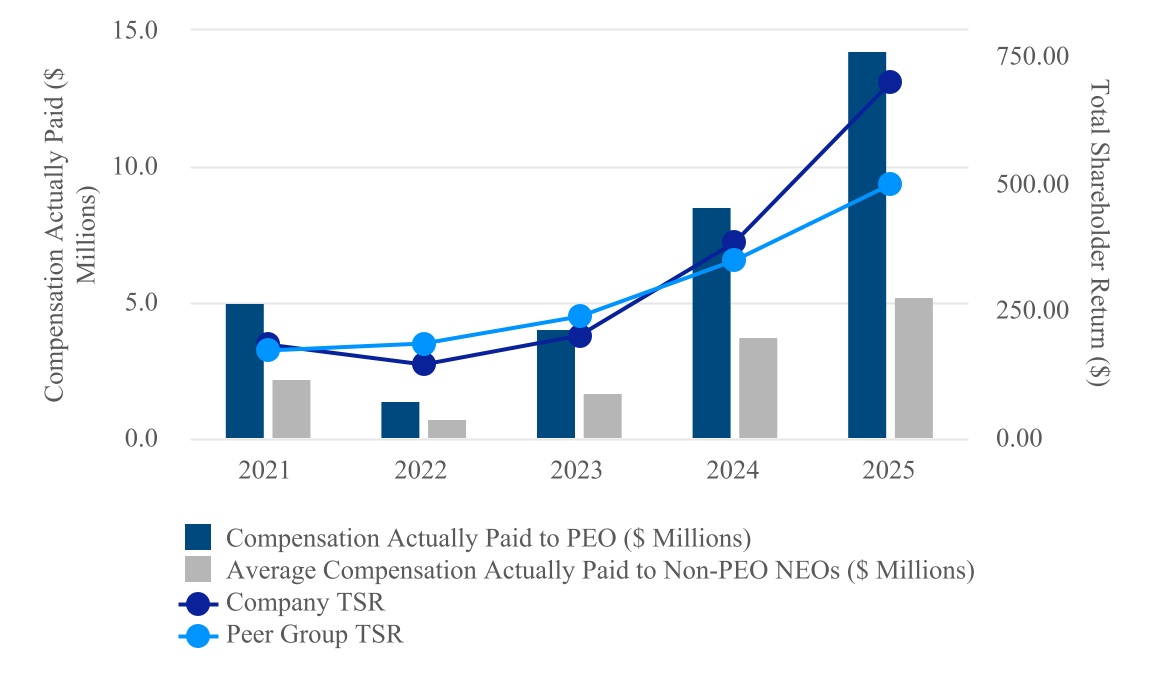
Relationship Between PEO and Average Non-PEO NEO Compensation Actually Paid and Net Income
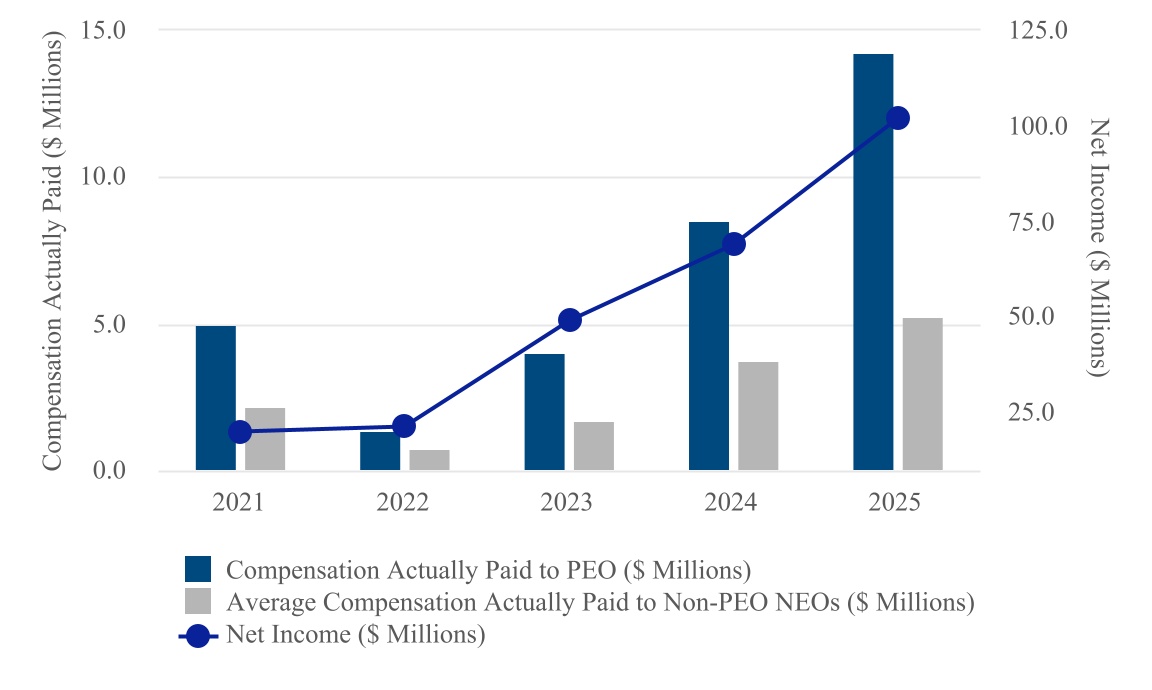
47
Relationship Between PEO and Average Non-PEO NEO Compensation Actually Paid and Revenue
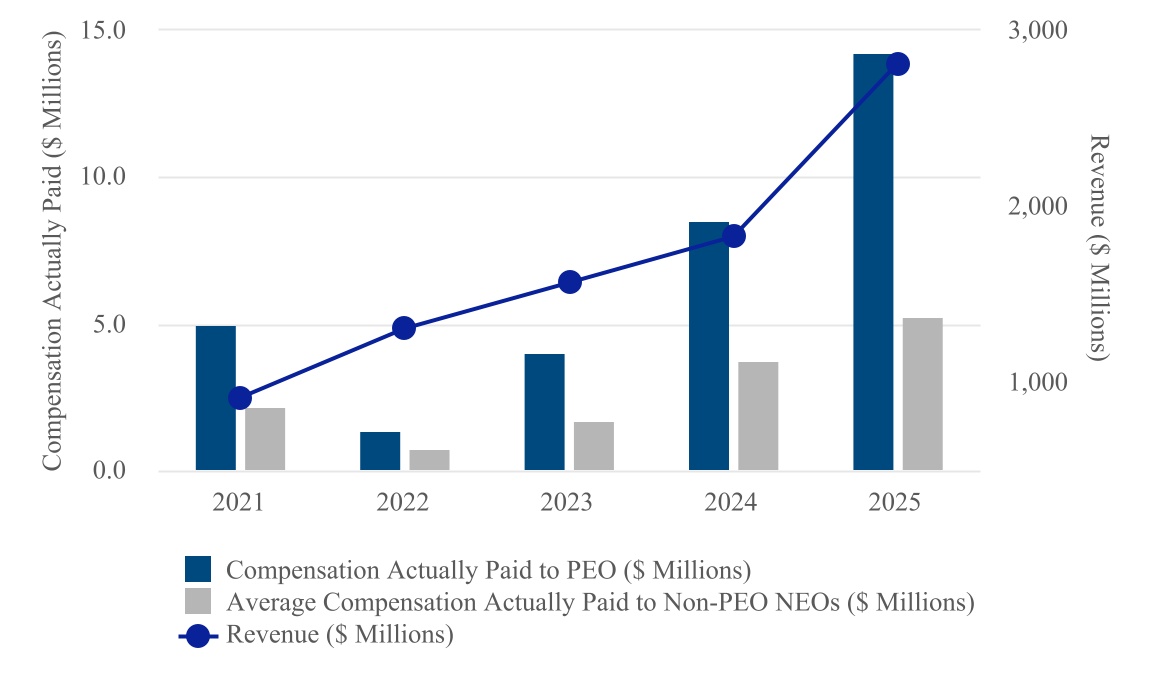
The following table lists the four financial performance measures that we believe represent the most important performance measures used to link compensation actually paid to our PEO and non-PEO NEOs for 2025 to our performance:
(1) | |||||
48
Compensation Committee Interlocks and Insider Participation
During fiscal 2025, the members of the Compensation Committee were Messrs. Fleming, Matteson and Shaffer, none of whom was, during the fiscal year, an officer or employee of the Company and none of whom, other than Mr. Matteson, has ever served as an officer of the Company. During fiscal 2025, none of our executive officers served as a director or member of the compensation committee (or other committee serving an equivalent function) of any other entity whose executive officers served on our Compensation Committee or on the Board.
The following is a summary of certain relationships and transactions involving members of our Compensation Committee requiring disclosure under Item 404 of Regulation S-K. Transactions involving SunTx and its affiliates may be attributed to Messrs. Fleming and Matteson as a result of their status as directors and officers of SunTx.
•We are a party to a management services agreement with SunTx Capital Management, an affiliate of SunTx. Pursuant to the agreement, SunTx Capital Management provides management services to us, including with respect to financing, business strategies and business development. For these management services, we paid SunTx Capital Management approximately $2.8 million during the fiscal year ended September 30, 2025. The management services agreement expires on October 1, 2028.
•We have entered into indemnification agreements with each of our current directors and executive officers. We anticipate that future directors and executive officers will enter into indemnification arrangements with us in substantially similar form. The indemnification agreements generally provide, among other things, that we will indemnify and hold harmless each person subject to such agreement (each, an “indemnitee”) to the fullest extent permitted by applicable law from and against all expenses, losses, damages, judgments, fines and other specified costs that may result or arise in connection with such indemnitee serving in his or her capacity as a director or executive officer of the Company or serving at our direction as a director, officer, employee or agent of another entity. These agreements further provide that, upon an indemnitee’s request and subject to certain conditions, we will advance expenses to the indemnitee. Pursuant to the indemnification agreements, an indemnitee is presumed to be entitled to indemnification, and we have the burden of proving otherwise. The indemnification agreements also provide that, to the extent that we maintain an insurance policy providing liability insurance for directors, officers, employees, agents or fiduciaries of the Company, indemnitees shall be covered by such policy to the maximum extent of the available coverage. The foregoing is only a brief description of the indemnification agreements, does not purport to be complete and is qualified in its entirety by reference to the Company’s form of indemnification agreement, which previously has been filed with the SEC.
•We are a party to an access agreement with Island Pond Corporate Services, LLC (“Island Pond”) regarding certain property owned by affiliates of Ned N. Fleming, III, the Executive Chairman of our Board and Managing Partner of SunTx. Pursuant to the agreement, we have a non-exclusive right to use certain land located in Baker County, Georgia for the purpose of business development. We paid Island Pond $400,000 during the fiscal year ended September 30, 2025 pursuant to the terms of the agreement.
49
Compensation Committee Report
The Compensation Committee has reviewed and discussed the Compensation Discussion and Analysis with management. Based on this review and discussion, the Compensation Committee recommended to the Board that the Compensation Discussion and Analysis be included in this Proxy Statement and incorporated by reference in the Company’s 2025 Annual Report.
Submitted by the Compensation Committee of the Board.
Ned N. Fleming, III, Chairperson | |||||
| Mark R. Matteson | |||||
| Stefan L. Shaffer | |||||
50
CERTAIN RELATIONSHIPS AND RELATED PARTY TRANSACTIONS
Review and Approval of Related Party Transactions
Our Board has adopted a written policy for the review, approval and ratification of transactions with related parties. The policy covers transactions between the Company and any of our executive officers and directors or their respective affiliates, director nominees, 5% or greater security holders or family members of any of the foregoing. Our Audit Committee reviews transactions covered by this policy to determine, among other things:
•whether the terms of the transaction are fair to the Company, have resulted from arm’s length negotiations and are on terms at least as favorable as would apply if the transaction did not involve a related party;
•whether there are demonstrable business reasons for the Company to enter into the transaction;
•whether the transaction is material to the Company;
•the role the related party played in arranging the transaction;
•whether the transaction could impair the independence of a director; and
•the interests of all related parties in the transaction.
A related party transaction will only be approved or ratified by the Audit Committee if the Audit Committee determines that the transaction is beneficial to the Company and the terms of the transaction are fair to the Company.
Prior to adopting a formal related party transaction policy, our management and Board reviewed and approved related party transactions on a case-by-case basis. The terms of the related party transactions and agreements described below were determined by and among affiliated entities and, consequently, are not necessarily the result of arm’s length negotiations. Although it is possible that we could have negotiated more favorable terms for such transactions with unrelated third parties, our management and Board believe that the terms of the related party transactions described below are reasonable, fair and beneficial to the Company.
Transactions with Related Parties
We have engaged in, and continue to engage in, related party transactions with certain current and former directors, members of management and beneficial holders of more than 5% of our common stock. The following summarizes certain transactions with these related parties.
Indemnification Agreements
We have entered into indemnification agreements with each of our current directors and executive officers. We anticipate that future directors and executive officers will enter into indemnification arrangements with us in substantially similar form. The indemnification agreements generally provide, among other things, that we will indemnify and hold harmless each indemnitee to the fullest extent permitted by applicable law from and against all expenses, losses, damages, judgments, fines and other specified costs that may result or arise in connection with such indemnitee serving in his or her capacity as a director or executive officer of the Company or serving at our direction as a director, officer, employee or agent of another entity. These agreements further provide that, upon an indemnitee’s request and subject to certain conditions, we will advance expenses to the indemnitee. Pursuant to the indemnification agreements, an indemnitee is presumed to be entitled to indemnification, and we have the burden of proving otherwise. The indemnification agreements also provide that, to the extent that we maintain an insurance policy providing liability insurance for directors, officers, employees, agents or fiduciaries of the Company, indemnitees shall be covered by such policy to the maximum extent of the available coverage. The foregoing is only a brief description of the indemnification agreements, does not purport to be complete and is qualified in its entirety by reference to the Company’s form of indemnification agreement, which previously has been filed with the SEC.
Other Transactions
We are a party to a management services agreement with SunTx Capital Management, an affiliate of SunTx. Pursuant to the agreement, SunTx Capital Management provides management services to us, including with respect to financing, business strategies and business development. For these management services, we paid SunTx Capital Management approximately $2.8 million during the fiscal year ended September 30, 2025. The management services agreement expires on October 1, 2028.
51
On December 31, 2017, we sold an indirect wholly owned subsidiary to Reid Smith, the brother of Fred J. (Jule) Smith, III, our President and Chief Executive Officer, in consideration for a note receivable in the amount of approximately $1.0 million, which approximated the net book value of the disposed entity. In connection with this transaction, we also received a separate note receivable from the disposed entity in the amount of approximately $1.0 million, representing certain accounts payable of the disposed entity that we had previously paid on its behalf. The notes do not bear interest. During fiscal 2025, the largest aggregate amount of principal outstanding was approximately $339,000, and the aggregate amount of principal paid on the notes was approximately $169,000. As of September 30, 2025, the aggregate remaining principal balance of the notes was approximately $170,000. Remaining payments are scheduled to be made in periodic installments through the 2026 fiscal year.
From time to time, certain of our subsidiaries have engaged Austin Trucking, LLC (“Austin Trucking”), an entity owned by Jacob R. Austin, the brother-in-law of Fred J. (Jule) Smith, III, our President and Chief Executive Officer, to perform subcontract work, including trucking services. During the fiscal year ended September 30, 2025, we incurred costs of approximately $9.5 million for these subcontract services. As of September 30, 2025, we had approximately $951,000 due to Austin Trucking reflected in accounts payable.
Prior to our acquisition of Fred Smith Company in 2011, Fred Smith Company advanced funds to an entity owned by Fred J. Smith, Jr., the father of Fred J. (Jule) Smith, III, our President and Chief Executive Officer, in connection with a land development project. In March 2021, Fred Smith Company amended and restated the terms of the repayment obligation, as a result of which Fred J. (Jule) Smith, III personally assumed the remaining balance of the obligation. No new amounts were advanced to Mr. Smith by the Company, Fred Smith Company or any subsidiary or affiliate thereof in connection with the transaction. Under the amended and restated terms, Mr. Smith executed a promissory note in favor of Fred Smith Company in the principal amount of approximately $774,000, bearing simple interest at a rate of 4.0% and requiring annual minimum payments of $100,000, inclusive of principal and accrued interest, with any remaining principal and accrued interest due and payable in full on December 31, 2027. The obligations of Mr. Smith under the promissory note are unsecured. During fiscal 2025, the largest aggregate amount of principal and interest outstanding under the note was approximately $548,000, and no principal or interest was paid on the note during the year. Subsequent to September 30, 2025, Mr. Smith paid the remaining balance of the note in full and satisfied all repayment obligations thereunder.
We are a party to an access agreement with Island Pond, an affiliate of Ned N. Fleming, III, the Executive Chairman of our Board and Managing Partner of SunTx. Pursuant to the agreement, we have a non-exclusive right to use certain land located in Baker County, Georgia for the purpose of business development. We paid Island Pond $400,000 during the fiscal year ended September 30, 2025 pursuant to the terms of the agreement.
Brandon Owens, the son of Charles E. Owens, our Vice Chairman, serves as President of Wiregrass Construction Company, Inc. (“Wiregrass”), our Alabama subsidiary. During the fiscal year ended September 30, 2025, Wiregrass paid Brandon Owens approximately $484,000 in salary and bonus, granted new equity awards having an aggregate grant date fair market value of approximately $101,000 and provided non-cash benefits having an aggregate value of approximately $35,000, representing approximately $620,000 paid to Mr. Owens during fiscal 2025 in connection with his employment.
Matthew Baugnon, the son of Robert G. Baugnon, our Senior Vice President - Personnel and Administration, serves as Director of HMA Plants for Fred Smith Company. During the fiscal year ended September 30, 2025, Fred Smith Company paid Matthew Baugnon approximately $201,200 in salary and bonus, granted new equity awards having an aggregate grant date fair market value of approximately $24,200 and provided non-cash benefits having an aggregate value of approximately $27,100, representing approximately $252,500 paid to Mr. Baugnon during fiscal 2025 in connection with his employment.
Joey Armstrong, the brother of M. Brett Armstrong, our Regional President - Central Region, serves as Business Development Manager of Wiregrass. During the fiscal year ended September 30, 2025, Wiregrass paid Joey Armstrong approximately $131,000 in cash compensation and approximately $17,000 in benefits, representing total compensation of approximately $148,000 paid to Mr. Armstrong during fiscal 2025 in connection with his employment.
52
DELINQUENT SECTION 16(a) REPORTS
Section 16(a) of the Exchange Act requires our directors and officers and persons who beneficially own more than 10% of any class of our equity securities to file with the SEC reports of ownership and changes in ownership of the Company’s common stock held by them. Copies of these reports must also be provided to the Company. Based on our review of these reports, we believe that, during the fiscal year ended September 30, 2025, all such reports that were required to be filed were filed on a timely basis, except that one report filed jointly by SunTx and Messrs. Fleming, Matteson and Jennings in December 2024 was filed subsequent to the applicable deadline. The report covered eight reportable transactions related to (i) distributions of shares of Class A common stock and Class B common stock from two SunTx funds to their respective limited partners for no consideration and (ii) automatic conversions of shares of Class B common stock into shares Class A common stock, which were triggered by the distributions.
53
REPORT OF THE AUDIT COMMITTEE
The Audit Committee of the Board is currently composed of three directors, all of whom satisfy the heightened independence requirements specified in Rule 10A-3 under the Exchange Act and the listing standards of Nasdaq. All members of the Audit Committee are financially literate, as that qualification has been interpreted by the Company’s Board in its business judgment, and two members of the Audit Committee qualify as “audit committee financial experts,” as that term is defined by the SEC. The Audit Committee operates under a written charter.
The Audit Committee hereby submits the following report:
•The Audit Committee has reviewed and discussed with management the Company’s audited consolidated financial statements.
•The Audit Committee has discussed with the Company’s independent registered public accountant, RSM, the matters required to be discussed by the applicable requirements of the Public Company Accounting Oversight Board (“PCAOB”) and the SEC.
•The Audit Committee has received and reviewed the written disclosures and the letter from RSM required by applicable rules of the PCAOB regarding RSM’s communications with the Audit Committee concerning independence, and has discussed with RSM their independence.
Based on the review and discussions referred to above, the Audit Committee recommended to the Board that the audited consolidated financial statements be included in our 2025 Annual Report. The information contained in this report shall not be deemed to be “soliciting material” or to be “filed with the SEC” or subject to the liabilities of Section 18 of the Exchange Act, nor shall such information be incorporated by reference into any future filing under the Securities Act or the Exchange Act, except to the extent that we specifically incorporate it be reference into such filing.
| Audit Committee: | |||||
Noreen E. Skelly, Chairperson | |||||
| Michael H. McKay | |||||
| Stefan L. Shaffer | |||||
54
PROPOSAL 1
ELECTION OF CLASS II DIRECTORS
General
Upon the recommendation of the Nominating and Corporate Governance Committee, the Board has nominated the following individuals for election as Class II directors of the Company to serve for a three-year term expiring at the 2029 Annual Meeting of Stockholders:
| Craig Jennings | Mark R. Matteson | |||||||||||||
Unless a stockholder instructs otherwise, shares represented by properly submitted proxies will be voted “FOR” the election of the director nominees listed above. The Board anticipates that the nominees listed above will be able to serve, but if any nominee should be unable or unwilling to serve, proxies will be voted for a substitute selected by the Board.
Vote Required; Board Recommendation
The election of directors will be determined by a plurality of the votes cast by the stockholders present in person or represented by proxy at the Annual Meeting and entitled to vote thereon. Under a plurality voting standard, the directors who are elected to serve on our Board will be the two nominees receiving the highest number of votes cast in the election.
The Board unanimously recommends that the stockholders vote “FOR” each of the nominees named above.
55
PROPOSAL 2
RATIFICATION OF APPOINTMENT OF INDEPENDENT REGISTERED PUBLIC ACCOUNTANT
The Audit Committee has appointed RSM as the Company’s independent registered public accounting firm for the fiscal year ending September 30, 2026. Stockholder ratification of the appointment is not required under Delaware law, but the Board has decided to ascertain the position of the Company’s stockholders on the appointment. The Audit Committee and the Board believe that the continued retention of RSM as the Company’s independent registered public accounting firm is in the best interests of the Company and its stockholders. If the appointment of RSM is not ratified, the Audit Committee may reconsider its appointment of RSM.
General
RSM audited our financial statements as of and for the fiscal year ended September 30, 2025 and has served as our independent registered public accounting firm since 2017. It is expected that a representative of RSM will be present at the Annual Meeting to respond to appropriate questions and will be given the opportunity to make a statement if he or she so desires.
Audit Committee Pre-Approval Policy
Our Board has a policy for the pre-approval of audit and non-audit services performed by the independent registered public accounting firm, pursuant to which the Audit Committee generally is required to pre-approve the audit and permissible non-audit services performed by the independent registered public accounting firm in order to ensure that the provision of such services does not impair the accountant’s independence. The Audit Committee considers non-audit fees and services when assessing the accountant’s independence. Unless a type of service to be provided by the independent registered public accounting firm has received general pre-approval and is within any preestablished fee limits, the service will require specific pre-approval by the Audit Committee. Any amounts invoiced for services rendered that materially exceed pre-approved cost levels will require specific approval by the Audit Committee prior to the payment of such invoice. On an annual basis, the Audit Committee may pre-approve specific services that are expected to be provided to the Company by the independent registered public accounting firm during the following twelve months. The most recent pre-approval occurred in November 2025. The Audit Committee may delegate pre-approval authority to one or more of its members, who in turn must report any pre-approval decisions to the Audit Committee at its next scheduled meeting.
Fees Paid to RSM
The following table presents fees for professional services rendered by RSM for the audit of the Company’s annual financial statements for the fiscal years ended September 30, 2025 and 2024, and fees billed for other services rendered by RSM during those periods, inclusive of out-of-pocket expenses.
| 2025 | 2024 | |||||||||||||||||||
| Audit Fees | $ | 3,365,300 | $ | 2,433,215 | ||||||||||||||||
| Audit-Related Fees | — | — | ||||||||||||||||||
| Tax Fees | — | 33,017 | ||||||||||||||||||
| All Other Fees | — | — | ||||||||||||||||||
| $ | 3,365,300 | $ | 2,466,232 | |||||||||||||||||
Audit Fees. This category includes fees and expenses for professional services related to the audit of the Company’s financial statements and review of financial statements included in the Company’s Quarterly Reports on Form 10-Q, as well as services that are normally provided by RSM in connection with statutory and regulatory filings. Specifically, the amounts in the table above represent fees and expenses related to (i) the audit of the Company’s annual financial statements for the fiscal years ended September 30, 2025 and 2024, including testing of our internal controls related to the requirement under Section 404 of the Sarbanes-Oxley Act for RSM to opine on our internal controls and a standalone audit of our wholly-owned captive insurance company, (ii) review of the Company’s interim financial statements and related disclosures included in periodic reports filed with the SEC, (iii) work performed in connection with the Company’s registration statement on Form S-3 filed during fiscal 2025 and the Company’s registration statement on Form S-8 filed during fiscal 2024, as well as certain pro forma financial information required to be prepared and reported in respect of the Lone Star Acquisition during fiscal 2025, and (iv) audit services related to subsidiary-level financial data of our operating companies for submission to, and for purposes of qualifying our operating companies to perform work with, various state Departments of Transportation. In each case, these services were approved by the Audit Committee pursuant to the pre-approval policy described above.
56
Audit-Related Fees. This category includes fees billed for assurance and related services that are reasonably related to the performance of the audit or review of the Company’s financial statements and are not included in Audit Fees. There were no such fees for the 2025 or 2024 fiscal years.
Tax Fees. This category includes fees billed for professional services related to tax compliance, tax advice and tax planning. For the 2024 fiscal year, the amount in the table above relates to the preparation of federal and state corporate income tax returns, tax consultation with respect to acquisitions and other corporate tax matters. In each case, these services were approved by the Audit Committee pursuant to the pre-approval policy described above.
All Other Fees. This category includes fees billed to the Company for products and services provided by RSM that do not fall into one of the other three categories above. There were no such fees during the 2025 or 2024 fiscal years.
Vote Required; Board Recommendation
The ratification of the appointment of RSM as the Company’s independent registered public accounting firm requires the affirmative vote of a majority of the votes cast by the stockholders present in person or represented by proxy at the Annual Meeting and entitled to vote on the proposal.
The Board unanimously recommends that the stockholders vote “FOR” Proposal 2.
57
OTHER MATTERS
As of the date of this Proxy Statement, the Board does not know of any business that will be presented for consideration at the Annual Meeting other than as specified herein and in the Notice, but if other matters are presented, it is the intention of the persons designated as proxies to vote in accordance with applicable law and their judgment on such matters.
DEADLINE FOR STOCKHOLDER PROPOSALS
In order for a proposal by a stockholder of the Company to be eligible to be included in the proxy statement and form of proxy for the 2027 Annual Meeting of Stockholders pursuant to the proposal process prescribed by Rule 14a-8, the proposal must be received by the Secretary of the Company at Construction Partners, Inc., 290 Healthwest Drive, Suite 2, Dothan, Alabama 36303, on or before September 29, 2026. However, pursuant to Rule 14a-8, if the 2027 Annual Meeting of Stockholders is held on a date that is before February 22, 2027 or after April 23, 2027, then a stockholder proposal submitted for inclusion in the proxy statement for the 2027 Annual Meeting of Stockholders must be received by us a reasonable time before we begin to print and mail our proxy statement for the 2027 Annual Meeting of Stockholders.
If a stockholder is (i) submitting a proposal outside the proposal process mandated by Rule 14a-8 to be presented at the 2027 Annual Meeting of Stockholders or (ii) nominating an individual for election as a director at the 2027 Annual Meeting of Stockholders, in each case pursuant to the advance notice provisions of the Company’s Amended and Restated By-Laws, the proposal or nomination must be received by the Secretary of the Company at 290 Healthwest Drive, Suite 2, Dothan, Alabama 36303 not earlier than November 24, 2026 or later than December 24, 2026, together with the necessary supporting documentation required under that by-law provision; provided, however, that if and only if the 2027 Annual Meeting of Stockholders is not scheduled to be held between February 22, 2027 and May 23, 2027, then such stockholder’s proposal or nomination must be received by the Secretary of the Company at 290 Healthwest Drive, Suite 2, Dothan, Alabama 36303 not earlier than the 120th day before the date of the 2027 Annual Meeting of Stockholders and not later than the later of (i) the 90th day before the date of the 2027 Annual Meeting of Stockholders or (ii) the 10th day following the day on which public announcement of the date of the 2027 Annual Meeting of Stockholders is first made by the Company.
ANNUAL REPORT ON FORM 10-K
You may receive a copy of our 2025 Annual Report without charge by sending a written request to Construction Partners, Inc., 290 Healthwest Drive, Suite 2, Dothan, Alabama 36303, Attention: Secretary.
58